Published 8 September 2026

Share this article
The Biggest Sales Coaching Gap Isn't Capability. It's Coaching.
A few weeks ago, I wrote about what I described as the CRM Elephant Graveyard. It was a reflection on the countless CRM implementations that promised to transform sales performance yet ultimately became little more than reporting systems. Looking back, I concluded that technology had never been the real problem. We expected software to change behaviour when behaviour has always been a human challenge.
That article generated a number of conversations, but one thought has remained with me ever since.
If technology doesn’t change sales behaviour, then what does?
For me, the answer has always been remarkably simple. Coaching. Not annual appraisals. Not pipeline reviews. Not forecast meetings. Genuine sales coaching.
As another week begins, salespeople across every industry will prepare for customer meetings. Some will be introducing themselves to a new prospect for the very first time. Others will be attempting to move a significant opportunity closer to a decision.
Many will be sitting in front of long-standing customers discussing projects that could
influence both organisations for years to come.
Every one of those meetings matters. What interests me is not what happens in the meeting itself, but what happens beforehand.
How many salespeople will sit down with their manager before those meetings to discuss what success actually looks like? How many will be challenged to think more deeply about the customer’s business objectives rather than simply their own?
How many managers will explore the stakeholders likely to influence the decision, test the
salesperson’s questioning strategy or ask what support they need before they walk through the customer’s door?
My suspicion is that those conversations have become increasingly rare. That observation is not intended as criticism of sales managers. In truth, I believe most are working harder than ever. Their responsibilities have expanded dramatically over the last two decades. Forecast accuracy, CRM compliance, internal governance, performance reporting, recruitment, one-to-ones, business reviews and endless internal meetings all compete for attention. None of these responsibilities are unimportant. Every organisation requires visibility, discipline and accountability.
The difficulty is that operational responsibility has gradually displaced developmental
responsibility. Somewhere along the way, many sales managers became exceptionally good at managing sales, while spending far less time developing salespeople.
That distinction matters. Managing sales is concerned with this month’s performance. Developing salespeople is concerned with every month that follows.
The organisations that consistently outperform their competitors rarely do so because they possess a better CRM, a more sophisticated dashboard or a more detailed forecast. They outperform because the quality of thinking inside customer meetings is consistently higher, and that quality of thinking is seldom created by accident. It is coached.
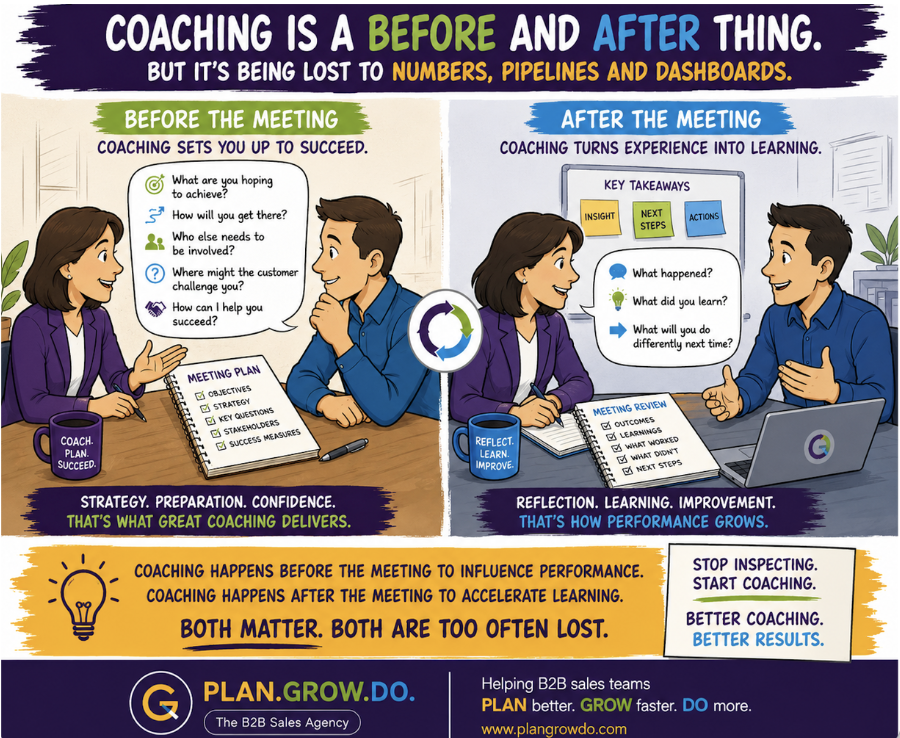
Coaching, however, is often misunderstood because we associate it almost exclusively with reflection. A customer meeting takes place, the salesperson returns to the office and the manager asks what happened, what they learned and what they would do differently next time. Those conversations are valuable because reflection transforms experience into learning. They are also incomplete.
The most influential coaching conversation takes place before the customer meeting has even started. It is during preparation that managers have the greatest opportunity to improve performance. They can challenge assumptions before they become mistakes, encourage broader stakeholder thinking before key people are overlooked and strengthen questioning strategies before opportunities are lost. They can help salespeople leave the office with greater clarity, stronger intent and more confidence than they arrived with.
When coaching happens both before and after customer interactions, something important changes. Preparation improves execution, execution creates experience and reflection converts that experience into capability. Each conversation reinforces the next until better sales behaviour becomes habit rather than aspiration.
Without that cycle, organisations often find themselves searching for the next solution.
A new sales methodology.
A new CRM.
A new training programme.
A new dashboard.
A new AI tool.
Each promises improvement, yet none of them can replace the conversation between a manager and a salesperson that challenges thinking, develops judgement and builds confidence.
Perhaps that explains why so many training programmes fail to create lasting change. The programme itself is rarely the issue. New ideas are introduced, people leave inspired and everyone intends to work differently. Then reality returns. Targets remain. Forecasts still need submitting. Internal meetings continue. Before long, the urgency of the business overtakes the importance of development.
The coaching that should have sustained the new behaviours never really happens. Ironically, I believe artificial intelligence may provide an opportunity to reverse that trend. If technology genuinely removes administrative burden, perhaps the greatest benefit will not be faster reporting or more accurate forecasts. Perhaps it will be something much more valuable.
Time. Time for managers to return to the activity that has always had the greatest influence on sustained sales performance: coaching their people before the meeting, helping them learn after the meeting and doing both with the same discipline they currently apply to forecasts and pipelines.
Looking back, I no longer think the biggest gap in sales is capability. Nor do I believe it is technology. I think the biggest gap is that somewhere between managing opportunities and managing numbers, we quietly stopped coaching the people responsible for both.