The power of a product selector: helping buyers choose and helping sales teams understand
Imagine you are responsible for a machining operation and your current metalworking fluid is causing problems. There is an unpleasant smell, the finish is inconsistent and you suspect the water on site is part of the issue. You know what is happening in your workshop. You may even know the product you use today. What you probably do not know is which of a supplier’s dozens of fluids, each with its own specifications and applications, deserves a closer look.
From inside a lubricant business, the differences between those products may be obvious. From the buyer’s side, a large range can look like a wall of similar names and technical data sheets. The choice matters because the wrong fit can affect equipment, process performance and confidence in the supplier. Faced with uncertainty, a buyer may keep researching, ask several suppliers the same question or delay the decision altogether.
This is where a product selector can earn its place. It gives the buyer a way to describe their job and their problem in familiar language, then guides them towards a manageable shortlist and a sensible next step.
Buyers are already doing the work
Our Buyer Revolution research on solving your own problems looks at how lubricant buyers research independently. Across the wider research, 94.1% said they research independently before speaking to anyone, and 77.7% already know what they want by the time they engage a seller. You can see the same pattern in our article on how far buyers have travelled before they reach out.
Knowing what you want does not mean every technical detail has been settled. A buyer might know the application, the symptoms and the outcome they need, while still wanting reassurance about compatibility, approvals or the practical implications of changing product. In another part of the Buyer Revolution findings, 77.7% said they engage sellers primarily for product or application knowledge. That tells us something useful about the salesperson’s role: buyers increasingly arrive with a view, and expect the conversation to take them further.
Research beyond lubricants points in a similar direction. Gartner’s 2025 B2B buyer survey found that buyers favoured self-service for general information but sought seller input when deciding whether a product fitted their specific needs. McKinsey’s 2024 B2B Pulse found demand for in-person, remote and digital self-service interactions throughout the buying journey. A useful digital experience should therefore make the eventual human conversation better.
What a good selector actually does
A product selector starts with the buyer’s situation. What are they trying to do? What equipment or materials are involved? What is going wrong? What are they using now? Where the buyer does not know a technical answer, the journey should let them say so.
From there, it narrows a complicated catalogue to a small number of relevant options, with a plain-English explanation of why each may fit. It can point to a data sheet, highlight a question that still needs answering and offer the buyer a choice of what to do next: explore, request a sample, ask a technical specialist, get a quote or buy where that is appropriate.
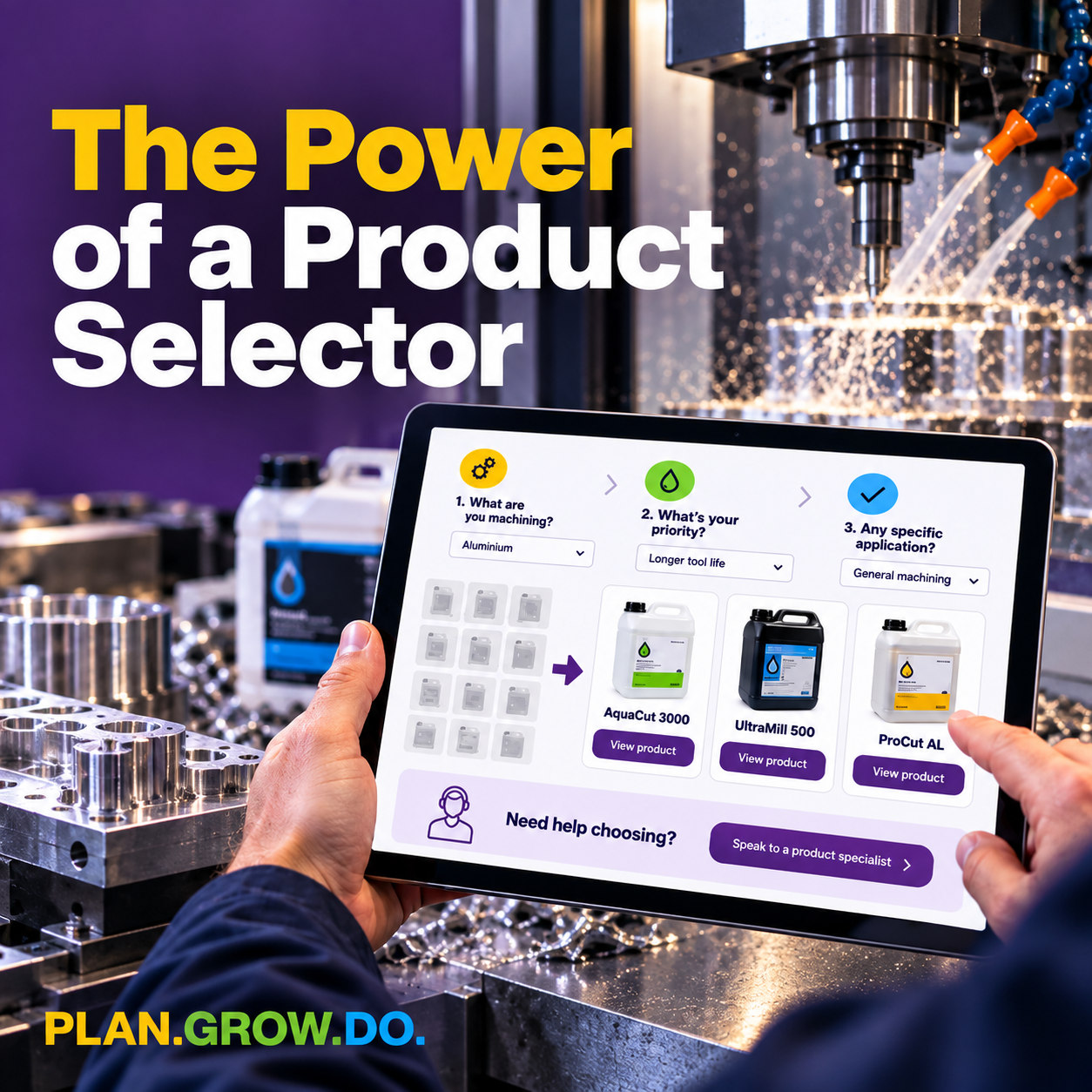
Our Product Selector is built around this kind of journey. It can work with a supplier’s own range or a multi-brand catalogue. The buyer answers questions in their own words and receives three ranked recommendations with an explanation. The same information can accompany an enquiry to a named sales representative through a CRM or Always On, so the conversation begins with context already in hand.
For a buyer, that feels like being helped before being sold to. For a supplier, it is an opportunity to demonstrate application knowledge at the very moment someone needs it. That is a more memorable experience than another catalogue page promising to cover “all your needs”.
The intelligence begins before the enquiry
Think about what a conventional contact form tells a salesperson: a name, an email address and perhaps “please call me about metalworking fluid”. Now consider the first call when the rep already knows the operation, the materials being machined, the buyer’s current product, the symptoms they have selected and the options they have been shown.
The rep can ask a sharper question. They can check the constraints the selector could not confirm. They can prepare the relevant data, involve a technical colleague if needed and respond with an understanding of the buyer’s problem. If the buyer has asked for help, routing that brief promptly to the right person also reduces the familiar gap between digital interest and sales action.
There is a second layer of intelligence too. Patterns across selector journeys can show marketing and product teams which problems buyers describe most often, where they are unsure, which applications are generating interest and where the range is difficult to navigate. Used thoughtfully, those insights can improve content, training and the questions salespeople ask. Our piece on sales and marketing alignment in lubricants explores why connecting these signals matters.
A practical place for AI in the workflow
The case for AI becomes clearer when it helps with a specific job. Our AI Readiness Research found that 85% of contributors use AI occasionally or regularly, while 55% rated their organisation’s readiness at just one or two out of five. Half wanted more practical use cases, and 59% named accuracy as their biggest concern.
A selector is one tangible answer to that gap. AI can help interpret a buyer’s description of an application or symptom, bring relevant options forward and explain the reasoning in accessible language. The workflow can then carry the buyer’s answers, shortlist and unresolved questions to a salesperson. This connects buyer support, qualification, technical knowledge and follow-up in one journey, rather than leaving AI as a separate tool someone occasionally uses to draft an email.
Accuracy has to be designed in. Product data needs to be current; technical exclusions, approvals and compatibility rules need to be explicit; and the tool needs to recognise when it lacks enough information. In higher-risk applications, a shortlist should lead to technical validation before anyone treats it as a final specification. Our wider AI product development approach starts with the commercial problem and tests a build against real scenarios and the people who will use it.
An easier choice builds trust
The opportunity is bigger than reducing the number of clicks between a homepage and a product page. A useful selector lets a supplier show how it thinks, what questions it asks and how it handles uncertainty. It gives the buyer more confidence to take a next step and gives the sales team a better starting point when they do.
In markets where many suppliers carry capable products, the experience of choosing can make one business stand out. If your range is difficult to navigate, start by listening to the questions buyers ask your best technical people. Those questions are often the beginnings of a selector that makes your expertise available earlier, and makes every conversation that follows more valuable.
Explore the Product Selector or see how we approach AI product development for technical businesses.