Published 8 September 2026

Share this article
Are We Still Recruiting Hunters for Yesterday's Buyer?
I have always understood why sales organisations separated hunters from farmers.
In truth, I spent much of my own career doing exactly the same. It made perfect sense. One role existed to create new opportunities, the other to develop existing ones. Buyers behaved differently, the commercial challenge was different and, naturally, the capabilities required appeared different too.
Organisations recruited differently, trained differently and rewarded differently because success demanded different behaviours.
Looking back, I don’t think that thinking was wrong. I simply think it belonged to a different buying environment.
What has occupied my thinking recently isn’t whether organisations still need hunters. They absolutely do. Every business depends upon people capable of creating opportunities that didn’t previously exist. My question is whether we are still expecting those people to behave like hunters from twenty years ago.
The buyer has changed beyond recognition, yet I can’t help feeling we continue to define the hunter in the likeness of the past rather than in the context of today’s buyer.
Our Buyer Revolution research, built upon more than 25,000 buyer data points gathered from procurement professionals, engineers, operational managers and technical decision-makers across the lubricants industry, challenged several assumptions I had held for years. Buyers are educating themselves earlier, researching independently, validating suppliers through their professional networks and often delaying engagement with sales until they have already developed a clear understanding of both the problem they are trying to solve and the solutions available to them.
That research didn’t convince me that hunting had become less important. If anything, it convinced me of the opposite.
Creating opportunities has become even more important because buyers are becoming increasingly selective about who earns the right to be part of their decision-making process.
What changed my thinking was not the importance of the role, but the capabilities now required to perform it successfully.
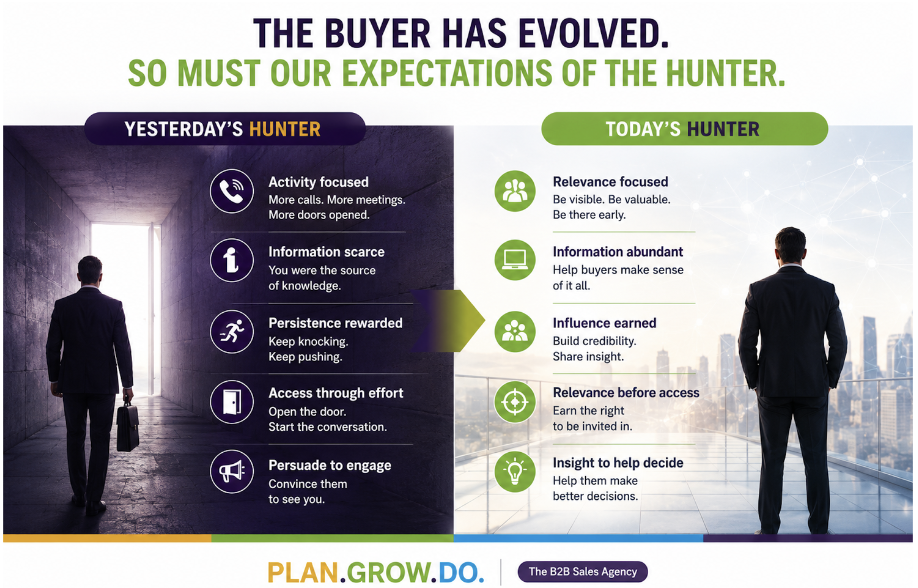
The traditional hunter operated in a marketplace where information was limited and suppliers were often the buyer’s primary source of knowledge. Opening a conversation created value because the conversation itself introduced new ideas, new products and new possibilities. Persistence mattered because buyers were largely dependent upon salespeople to help them understand what was available.
Today’s buyer begins somewhere very different.
Long before a salesperson introduces themselves, buyers have often spoken to colleagues, searched online, read technical papers, explored supplier websites, watched webinars and formed opinions about the organisations they consider credible. By the time sales becomes involved, the buying journey is frequently well underway.
That should cause every sales leader to pause because it fundamentally changes what creating new business actually means.
For many years we measured hunting through activity. Calls made, appointments booked, doors opened and opportunities created became the accepted measures of success because they reflected the buying behaviour of the time. There remains value in every one of those activities, but they no longer represent the whole picture because they no longer represent the beginning of the buyer’s journey.
It is becoming increasingly difficult to argue that hunting is still primarily an outbound discipline. The modern buyer moves seamlessly between digital and physical channels, gathering information, validating assumptions and narrowing potential suppliers long before a salesperson receives an enquiry. If that is how buying now takes place, then creating new opportunities must also become an omnichannel discipline. Commercial success is increasingly influenced by whether buyers can discover your expertise, trust your reputation and learn from the insight you share before they are ever ready to have a sales conversation. Those activities have traditionally been viewed as supporting sales. I would argue they have now become sales.
Perhaps the real challenge is not that organisations have failed to adapt to modern buying behaviour. In many respects they have. Most now invest in digital marketing, CRM, social selling, buyer personas and AI-enabled tools. Yet when it comes to the people responsible for creating new business, I can’t help feeling we are still holding on to a legacy. We continue to define the hunter in the likeness of the past rather than in the context of today’s buyer. We still celebrate persistence over presence, activity over influence and interruption over relevance, despite overwhelming evidence that buyers now begin their journey very differently.
What interests me is that this legacy often reveals itself not in the recruitment process but in the expectations placed upon people once they are in the role.
New business salespeople are still measured by activity, encouraged to ‘get out there’, make more calls, book more meetings and keep filling the top of the funnel. Those disciplines undoubtedly retain value, but they are no longer sufficient on their own.
The modern buyer expects the salesperson creating new opportunities to be equally capable of building digital credibility, sharing insight, understanding commercial context and becoming visible long before a conversation ever takes place. In many organisations, however, those activities are still viewed as marketing, personal branding or something to do in spare moments rather than being recognised as core components of modern business development.
Interestingly, the same research that challenged my thinking about hunting also challenged my thinking about account management.
When buyers described the people they valued most, they didn’t separate the qualities they expected from someone winning new business from those they expected after the relationship had been established. They consistently described professionals who understood their application, responded quickly, demonstrated commercial awareness, shared relevant insight, followed through on commitments and invested time understanding the wider business rather than simply promoting products. Those qualities influenced whether buyers engaged with a supplier in the first place just as much as they influenced whether they remained loyal afterwards.
The more I reflected on those findings, the more I began to question whether we have misunderstood the distinction between hunters and farmers altogether.
Perhaps it was never really about new customers versus existing customers.
Perhaps it was about how value was created at different stages of the buyer’s journey. Historically, hunters created value because they were the gateway to information. They introduced buyers to products, technologies and possibilities that would otherwise have remained unknown. Today, buyers have already completed much of that discovery for themselves before sales becomes involved. The opportunity to create value has not disappeared, but it has moved. It now lies in helping buyers navigate complexity, interpret competing information, understand commercial implications and build the confidence to make good decisions. If that is true, then many of the capabilities we once associated with outstanding account managers have quietly become the capabilities required to win new business as well.
This changing understanding was one of the reasons we developed SPANCOP differently.
Many sales methodologies begin with Prospecting because they assume an opportunity already exists. We deliberately chose not to. SPANCOP begins with Suspecting, because opportunities do not begin when a salesperson picks up the telephone. They begin when something changes inside a customer’s business. A reliability issue emerges. A production target changes. New legislation arrives.
Equipment reaches the end of its operational life. A sustainability objective is introduced. A strategic investment is approved. Those events create the conditions from which opportunities develop whether sales are present or not.
The responsibility of the modern commercial professional is therefore not to manufacture demand but to recognise those signals earlier than competitors, understand their commercial significance and position themselves as someone capable of helping the buyer navigate the decisions that follow.
That is why we often remind our clients that suspects never buy.
A suspect is simply an organisation exhibiting signals that change may be taking place. Those signals might come from digital engagement, LinkedIn activity, referrals, market intelligence, operational announcements, customer insight or countless other sources of information that collectively suggest a conversation may now be worthwhile. Suspecting has therefore become an omnichannel discipline because modern opportunity creation has become an omnichannel discipline.
Prospecting follows only when there is sufficient evidence that a genuine commercial
issue may exist, and even then, its purpose is frequently misunderstood. Effective prospecting is not a numbers exercise designed to populate a CRM. It is a disciplined qualification process that determines whether the business problem is significant enough to justify investing time for both buyer and seller.
Approach and Analyse then becomes the natural continuation of that thinking.
Rather than persuading a customer to consider change, the objective is to understand the business well enough to define success, establish meaningful measures, involve the right stakeholders and determine whether sufficient value exists to justify moving forward. It is, in many respects, the point where selling begins to look much more like collaborative decision-making than traditional persuasion.
Looking back at The Future Lubricants Salesperson, I have also found myself reflecting on one of our own conclusions. When we identified ten buyer-backed behaviours that define tomorrow’s commercial professional, I originally considered them the attributes of an exceptional account manager. Today, I see something different. Those same behaviours describe the capabilities required to create new business in a world where buyers increasingly educate themselves before sales ever becomes involved.
Responsiveness, technical expertise, insight, reliability, commercial understanding and genuine curiosity are no longer specialist account management skills. They are becoming the defining characteristics of the modern commercial professional.

Perhaps that is the opportunity now facing sales leaders.
Not to abandon the hunter, nor to romanticise the past, but to redefine what hunting means in the context of how buyers actually buy. If we continue to hold on to a legacy definition of the hunter, we risk coaching talented people to excel in a buying environment that no longer exists. If, however, we are prepared to redefine the role through the eyes of today’s buyer, we have an opportunity to build a generation of commercial professionals capable of creating value long before a proposal is written or a meeting is booked.
For me, that feels like a far more important conversation than whether someone is a hunter or a farmer. It feels like a conversation about the future of sales leadership itself.