AI Didn't Break CRM. It Exposed What We Got Wrong.
Every so often, a technological shift comes along that encourages us to re-examine assumptions we have accepted for years. Artificial intelligence feels like one of those moments. Much of the current conversation centres on whether AI will replace Customer Relationship Management (CRM), but I believe that is the wrong debate. AI isn’t making CRM redundant; it is exposing weaknesses that have existed ever since CRM first became a boardroom priority. More importantly, it is forcing us to ask whether we have always expected CRM to solve problems it was never designed to address.
That question has caused me to reflect on my own experience. During my time at Shell, I was fortunate to lead Sales Excellence programmes across more than fifty countries, working with sales organisations of different sizes, cultures and levels of maturity. Regardless of geography, one challenge appeared with remarkable consistency. Organisations invested heavily in CRM platforms, dedicated significant resource to implementation and developed increasingly sophisticated reporting, yet adoption by the sales community remained frustratingly inconsistent. At the time, our natural response was to improve training, strengthen governance and reinforce compliance. If usage wasn’t where we wanted it to be, we assumed the answer lay in helping people understand the system better or encouraging managers to hold their teams more accountable.
Looking back, I no longer believe that was the real issue. Salespeople generally understood how to use CRM; what many struggled to understand was why they should. There is an important distinction between the two. We often confuse knowledge with motivation, assuming that once someone understands a process they will naturally embrace it. In reality, adoption depends far more on perceived value than technical understanding. If a salesperson cannot clearly see how a system helps them become more successful in front of customers, the system will inevitably feel like administration rather than enablement.
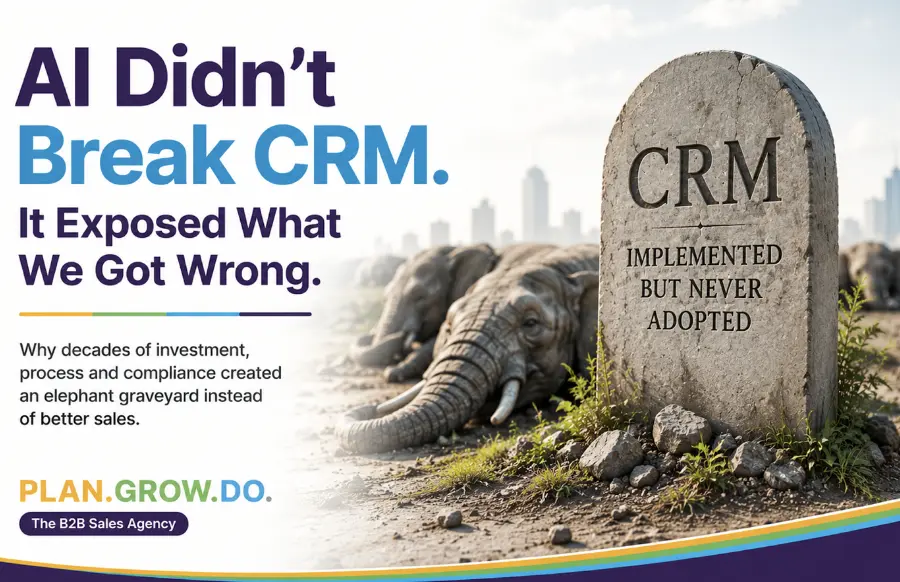
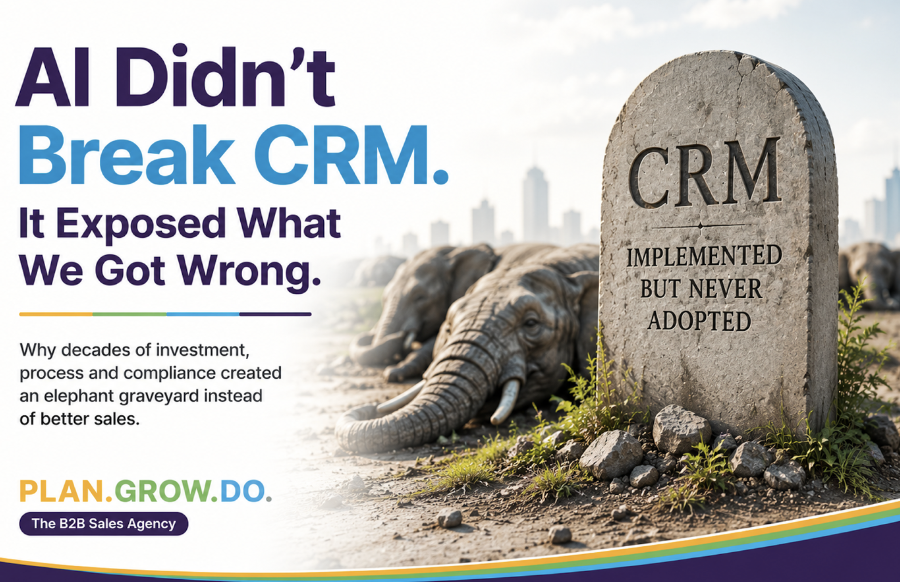
Perhaps that explains why so many CRM implementations have become what I often describe as. The technology itself is rarely the problem. In fact, today’s leading CRM platforms are more capable than ever before. The challenge is that they were largely designed to meet organisational objectives. They improve forecasting, increase pipeline visibility, strengthen governance, support opportunity management and provide leadership teams with valuable management information. These are all worthwhile outcomes and few organisations would choose to operate without them.
However, the immediate beneficiary is often the business rather than the individual salesperson responsible for maintaining the information.
From the salesperson’s perspective, the relationship has often felt unbalanced. They invest time entering data, updating opportunities and recording activities, while the greatest benefits are realised elsewhere in the organisation through improved reporting, forecasting and decision- making. Unsurprisingly, customer conversations usually take priority over administration. This has frequently been interpreted as resistance to
technology, when in reality it is often a rational response to competing priorities.
Salespeople don’t wake up each morning motivated by completing CRM records; they wake up thinking about customers, opportunities and the next conversation that might help them achieve their target.
The more I reflect on those years, the more another observation stands out. CRM evolved into an exceptional account management tool, but it never became an equally effective new business development tool. Once a customer relationship existed, CRM proved invaluable for managing contacts, tracking opportunities, coordinating activity and forecasting future revenue. It helped sales teams manage what they already knew.
What it rarely did was help them discover what they didn’t yet know.
Very few salespeople have ever started their day by opening their CRM system in the hope of finding their next prospect. Instead, they turned to industry news, referrals, LinkedIn, search engines, networking events, customer recommendations and their own curiosity. Suspecting happened outside CRM. Prospecting happened outside CRM. Understanding the customer’s business happened outside CRM. Even identifying whether a genuine opportunity existed usually happened long before an opportunity
record was ever created. CRM became extremely effective at documenting the journey once it had begun, but far less effective at helping salespeople decide where that journey should start.
That distinction became increasingly important as our own thinking evolved around SPANCOP. One of the reasons we deliberately place so much emphasis on Suspect, Prospect, Approach and Analyse is because these are the stages where salespeople create the greatest value, yet they are also the stages least supported by traditional CRM. Before anyone should be discussing products, proposals or closing techniques, they need to understand whether there is a genuine problem worth solving, who else needs to be involved in the decision, what success looks like from the buyer’s perspective and how that success might ultimately be measured.
These are not administrative activities; they are thinking activities. They demand curiosity, preparation and commercial judgement rather than data entry.
This thinking eventually led me to write The Blind Spot Before CRM. The central argument was simple. Organisations have spent decades trying to improve what happens inside CRM, while paying comparatively little attention to everything that happens beforehand. Yet it is often those earlier conversations that determine whether an opportunity deserves to exist in the first place. If we improve the quality of thinking before an opportunity enters the system, we naturally improve the quality of everything that follows.
Artificial intelligence has now accelerated that conversation. Much of the industry continues to ask whether AI will replace CRM, but I believe AI is revealing something far more significant. Unlike traditional CRM, which generally asks salespeople to contribute information for the benefit of the organisation, AI creates immediate value for the individual using it. It helps research industries, prepares account plans, summarises meetings, drafts proposals, identifies trends, analyses customer information and suggests possible next actions within seconds. The salesperson experiences the benefit immediately, rather than after completing an administrative process. That difference may prove to be one of the most important behavioural shifts we have seen in sales technology for decades.
The research increasingly supports this view. Gartner has reported that while organisations continue to increase investment in AI-powered sales technologies, many Chief Sales Officers still struggle to demonstrate meaningful return on investment because successful adoption depends less on the technology itself and more on organisational readiness, behavioural change and effective integration into existing ways of working.
Gartner also estimates that AI is already saving salespeople several hours each week, creating an opportunity to redirect that time towards higher- value customer engagement rather than administration. Those findings reinforce something many experienced sales leaders have known for years: technology rarely fails because of functionality; it fails because people struggle to see how it improves the way they work.
At the same time, there is another danger emerging. If AI simply accelerates existing behaviours, it also has the potential to accelerate poor ones. We can now generate emails faster, create proposals more quickly and produce customer summaries in seconds. However, if those outputs are built on weak qualification, poor understanding or superficial customer insight, all we have achieved is becoming faster at producing average work. This concern formed the basis of another article I wrote, Is AI Making Salespeople Lazy? The intention was never to criticise AI itself, but to challenge the assumption that faster automatically means better. AI should strengthen judgement, not replace it. It should help salespeople think more deeply about their customers rather than encouraging them to outsource their thinking altogether.
This is where I believe the future of sales technology begins to look very different. Rather than asking whether AI will replace CRM, perhaps we should be asking how AI can support the behaviours that CRM has always struggled to influence. How can it help salespeople prepare more effectively? How can it improve questioning? How can it encourage stronger qualification? How can it help managers coach more effectively instead of simply reviewing dashboards? These questions move the conversation away from systems and towards behaviours, which is where meaningful sales transformation has always begun.
Our own Buyer Revolution research reached a remarkably similar conclusion. Buyers consistently told us that they value expertise, relevance and commercial insight far more than they value another supplier presentation. They want salespeople who understand their business, ask thoughtful questions and help them make confident decisions. None of
those capabilities originate from a CRM system. They begin with curiosity, preparation and an understanding of how buyers actually buy. CRM may help us record those interactions afterwards, but it cannot create them in the first place.
That thinking ultimately shaped why we developed the Always On Sales Control System. It was never conceived as a replacement for CRM, because CRM continues to play an important role as the system of record for customer information. Instead, Always On was designed to address a different challenge entirely: helping salespeople make better decisions before they ever create an opportunity, supporting managers to coach
behaviours rather than chase updates and creating greater confidence that the opportunities entering CRM genuinely deserve to be there. In many respects, it occupies the space that has been overlooked for years—the behavioural layer that sits before administration.
Perhaps that is the most important lesson AI has given us. It has reminded us that successful sales transformation has never been determined by technology alone. Organisations rarely gain competitive advantage simply because they own better software; they gain it because their people think differently, behave differently and create better buying experiences. CRM remains an essential part of that picture and will undoubtedly continue to evolve as AI becomes more deeply embedded. However, if AI has exposed one truth, it is that recording activity has never been the same as
improving performance.
The organisations that thrive over the next decade will almost certainly continue to invest in CRM, but I suspect their real advantage will come from something else entirely. They will invest just as heavily in the quality of thinking that happens before the CRM system is ever opened. In the end, that may prove to be the blind spot we should have been focusing on all along.