AI Leadership in Industrial Businesses: The Difference Between Enablers and Gatekeepers
For many industrial businesses, AI is no longer a future discussion.
It is already affecting how buyers research, how commercial teams communicate, how technical support is delivered, how marketing is created, and how operational decisions are made.
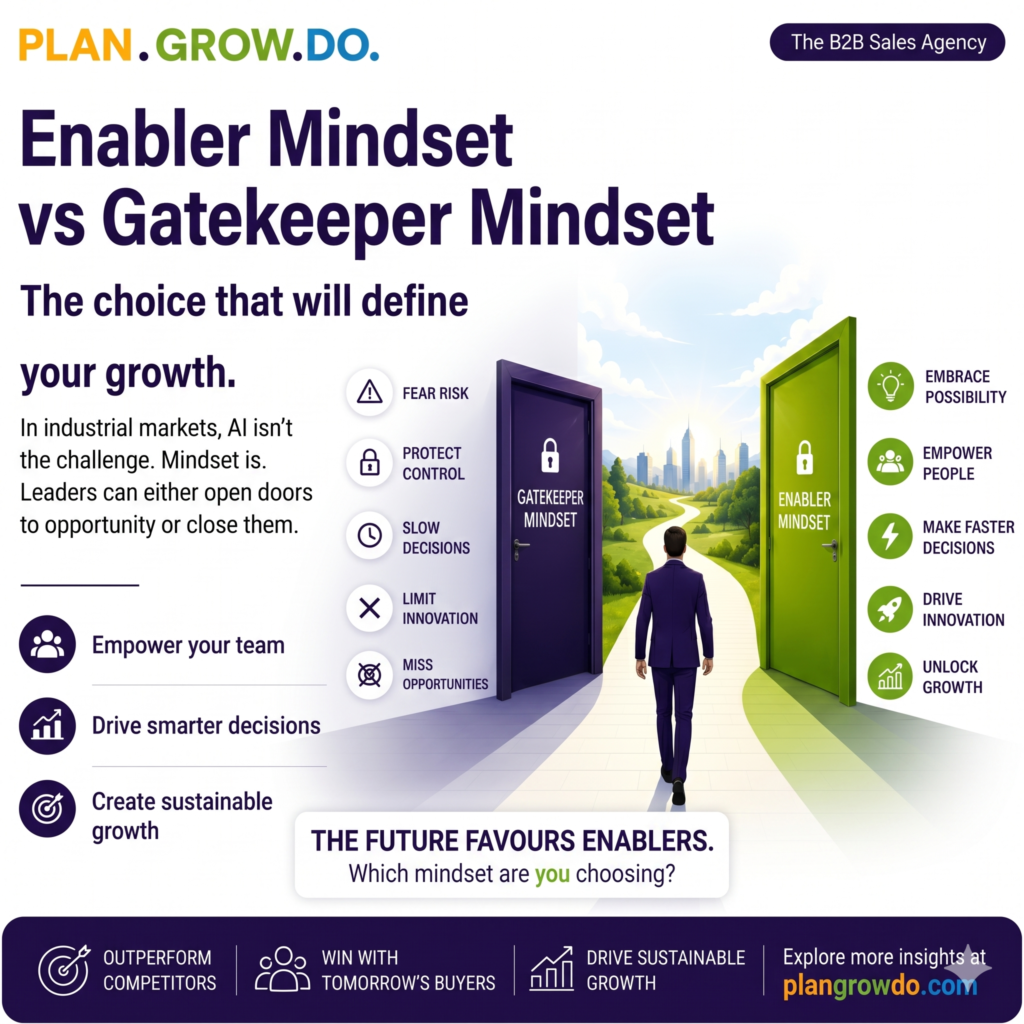
Yet despite the noise, investment, and urgency around AI, there remains a major divide inside organisations. Not between companies that have AI and companies that do not. But between leaders who act as enablers and leaders who act as gatekeepers.
This divide is becoming one of the defining characteristics of modern commercial leadership.
The uncomfortable truth is this: Many organisations are not struggling because AI is weak. They are struggling because leadership behaviour is.
The Real AI Problem Is Rarely Technical
Recent research from Harvard Business Review highlighted a growing disconnect between executives and middle managers when it comes to AI adoption.
Senior leaders often see opportunity. Middle management often sees disruption, uncertainty, or risk.
That tension slows adoption, creates organisational friction, and quietly kills momentum. Research also continues to show that many AI initiatives fail not because the tools are incapable, but because organisations are culturally unprepared to absorb change. (hbr.org)
This is particularly visible in industrial sectors. Manufacturing. Lubricants. Engineering. Industrial distribution. Technical services. Energy.
These sectors are filled with intelligent, commercially experienced people. But many businesses were built in an era where information was controlled carefully, hierarchy mattered heavily, and decision-making flowed slowly through layers of management.
AI fundamentally challenges that operating model.
Not because it removes humans. But because it redistributes access. Access to insight. Access to information. Access to analysis. Access to communication. Access to capability. And that creates an identity challenge for many leaders.
The Gatekeeper Mentality
Gatekeepers often emerge unintentionally. Most are not trying to damage progress. In fact, many became successful because they protected standards, managed risk carefully, and controlled quality.
The problem is that the same leadership behaviours that protected organisations in slower-moving environments can become barriers in faster-moving ones.
A gatekeeper mentality often sounds like this:
- “We need to wait until the technology matures.”
- “I don’t want the team using tools we can’t fully control.”
- “What if somebody gets it wrong?”
- “We need sign-off before anybody experiments.”
- “AI isn’t relevant to our industry.”
- “Our customers still buy traditionally.”
- “We’ve always done it this way.”
The surface-level reasoning usually sounds sensible. The deeper reality is often fear. Fear of losing control. Fear of exposing inefficiencies. Fear of role dilution. Fear of becoming less relevant. Fear of change happening faster than leadership can process.
Ironically, gatekeepers often believe they are protecting the business.
In reality, they frequently create:
- Slow decision-making
- Low experimentation
- Hidden employee frustration
- Shadow AI usage
- Reduced commercial responsiveness
- Internal bottlenecks
- Innovation fatigue
- Loss of competitive agility
One of the biggest risks is that gatekeeper cultures push AI activity underground. Employees still experiment. They still use tools. They still explore shortcuts. But they do it quietly. Without governance. Without collaboration. Without shared learning.
That is far riskier than structured enablement.
The Enabler Mentality
Enablers think differently. They understand that AI is not a replacement for leadership. It is an amplifier of leadership.
They focus less on controlling every action and more on creating frameworks that allow teams to move responsibly and intelligently.
An enabler mentality sounds more like this:
- “How do we help our people use this safely?”
- “What repetitive work could AI remove?”
- “How do we improve customer experience?”
- “Where are buyers already changing?”
- “How do we experiment without losing governance?”
- “What capability gaps do we need to address?”
- “How do we become more commercially responsive?”
The key difference is psychological. Gatekeepers try to preserve the old world. Enablers prepare people for the new one. That does not mean blind optimism.
Strong enablers still care deeply about:
- Governance
- Data security
- Accuracy
- Compliance
- Ethics
- Commercial risk
- Human oversight
But they approach those challenges with the mindset of: “How do we make this work responsibly?”
Not: “How do we stop this entirely?”
That distinction matters enormously.
Satya Nadella and the Shift From “Know-It-All” to “Learn-It-All”
One of the most referenced leadership transformations in modern business came under Microsoft CEO Satya Nadella.
When Nadella took over Microsoft, one of the cultural shifts he pushed heavily was moving from a “know-it-all” culture to a “learn-it-all” culture.
That idea matters hugely in the AI era. Because AI punishes rigid certainty.
The leaders who thrive now are often the leaders most willing to:
- Learn publicly
- Experiment visibly
- Adapt quickly
- Listen continuously
- Accept temporary discomfort
Microsoft itself has repeatedly discussed the importance of growth mindset, empathy, and continuous learning in driving innovation and transformation. (madrona.com)
Industrial businesses should pay attention to that. Because many commercial organisations still reward certainty over curiosity. Yet curiosity is rapidly becoming a competitive advantage.
AI Is Exposing Organisational Friction
AI is often described as a technology revolution.
In reality, it is also a mirror. It exposes:
- Poor communication structures
- Slow approvals
- Weak knowledge sharing
- Siloed teams
- Lack of process clarity
- Poor responsiveness
- Fragile leadership cultures
- Dependency on individuals rather than systems
This is why simply buying AI software rarely creates transformation. Many organisations are layering AI onto broken workflows.
Harvard Business Review recently highlighted that companies frequently adopt AI aggressively while only achieving marginal gains because they are trying to optimise existing systems rather than rethink how work actually happens. (hbr.org)
That is a critical point for industrial sectors. Especially commercial teams.
If your sales process is already slow, inconsistent, poorly prepared, and reactive, AI does not magically fix that. It simply accelerates the visibility of those weaknesses.
The Commercial Risk of Remaining a Gatekeeper
Many industrial businesses still underestimate how quickly buyer behaviour is changing. Today’s buyers increasingly:
- Research independently
- Compare suppliers digitally
- Expect rapid responses
- Want personalised communication
- Use AI themselves
- Self-educate before contacting suppliers
Businesses that operate with gatekeeper leadership cultures often struggle to respond at the speed modern buyers expect.
The result is not always dramatic collapse. More often, it is gradual erosion. Lost opportunities. Reduced responsiveness. Declining relevance. Longer decision cycles. Lower engagement. Weaker differentiation.
The danger is that these losses happen quietly. By the time leadership recognises the scale of the shift, competitors may already have built operational advantages that are difficult to catch.
What Enabling Leadership Actually Looks Like
Enabling leadership does not mean giving everybody unrestricted access to every AI tool. That is not leadership. That is avoidance. Real enablement requires structure.
Here are some of the behaviours increasingly seen in commercially progressive organisations:
1. Leaders Experiment First
The best leaders are not waiting for perfect certainty. They are actively using AI themselves.
Not because they want to become technical experts. But because they understand leadership credibility matters. Teams can spot immediately whether leadership curiosity is genuine or performative.
2. AI Is Framed Around Problems, Not Hype
Strong organisations are not asking: “What AI tools should we buy?”
They are asking:
- Where are we losing time?
- Where are buyers frustrated?
- Where are teams overloaded?
- Where are we inconsistent?
- Where are opportunities being missed?
This creates far more commercially useful adoption.
3. Governance Exists Early
The smartest businesses are not choosing between innovation and governance. They are embedding governance into experimentation from the beginning.
This includes:
- Clear policies
- Approved tools
- Human review processes
- Defined use cases
- Training
- Data handling rules
- Escalation frameworks
Good governance accelerates adoption. It does not suppress it. (qa.com)
4. AI Is Used to Augment Humans, Not Replace Them Blindly
The strongest organisations are using AI to:
- Improve preparation
- Increase responsiveness
- Reduce admin
- Surface insight faster
- Support decision-making
- Create consistency
- Strengthen customer experience
Not simply reduce headcount. Businesses that focus only on cost-cutting often damage trust internally and externally.
The Shift From Control to Capability
This may be the most important leadership transition of the AI era. Historically, many leaders built value by controlling information. Today, value increasingly comes from enabling capability. That changes the role of leadership itself.
The future commercial leader is less likely to be:
- The sole source of knowledge
- The bottleneck for approvals
- The controller of communication
And more likely to be:
- A strategic coach
- A capability builder
- A systems thinker
- A culture shaper
- A decision enabler
That transition can feel uncomfortable. Particularly for experienced leaders whose careers were built in more hierarchical environments. But resisting that shift will not stop it happening.
Questions Leaders Should Ask Themselves
For commercial leaders, MDs, CEOs, and sales directors, the most useful AI questions are often not technical. They are cultural.
Questions such as:
- Are our people afraid to experiment?
- Are approvals slowing responsiveness?
- Do we reward curiosity or certainty?
- Are teams hiding AI usage rather than discussing it openly?
- Are we preparing people for change or protecting them from it?
- Is leadership visibly learning?
- Are we redesigning workflows or simply adding tools?
- Are we becoming easier to buy from?
Those questions reveal far more about AI readiness than software selection ever will.
The Industrial Opportunity
Industrial sectors have a huge opportunity in front of them. Because many competitors are still early in their AI maturity. That creates space for businesses willing to move intelligently.
Particularly around:
- Commercial responsiveness
- Technical support
- Buyer education
- Knowledge management
- Proposal generation
- Sales preparation
- Customer experience
- Marketing relevance
- Operational visibility
The organisations that win are unlikely to be the ones shouting loudest about AI. They will more likely be the businesses quietly building cultures that learn faster than competitors. That is the real advantage. Not the tool. The mindset.
Final Thought
AI will not remove the need for leadership.
If anything, it will expose the quality of leadership more clearly than ever. Gatekeepers may slow change temporarily. But enablers build organisations capable of adapting continuously. And in an environment where technology, buyer behaviour, and commercial expectations are evolving rapidly, adaptability may become the single most important competitive advantage an industrial business can possess.
The question is no longer whether AI matters.
The question is whether leadership behaviour is helping organisations evolve with it. Or quietly preventing them from doing so.
Further reading
For additional thinking around AI, commercial responsiveness, and the changing industrial buyer journey: