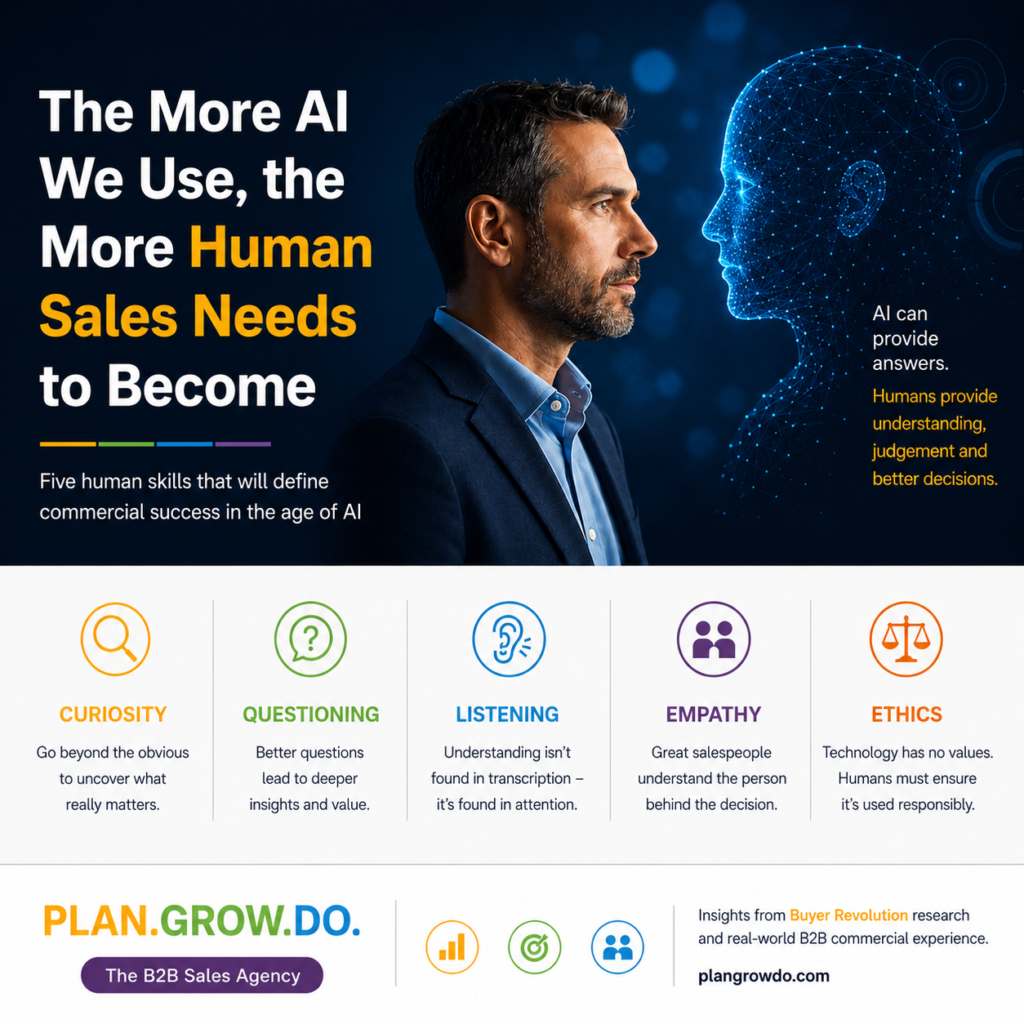
Five human skills that could become more valuable in the age of AI
There is an understandable focus in boardrooms at the moment on what AI can do. It can research accounts, analyse pipelines, summarise meetings, produce content, recommend products, draft proposals, identify buying signals and increasingly take action on behalf of sales and marketing teams.
For commercial leaders, much of the conversation has therefore centred on productivity.
Where can we save time? What can we automate? Which activities no longer require a
person?
Those are sensible questions, but there is another one that deserves just as much attention: if AI becomes capable of doing more of the work, what makes the human more valuable?
That question is particularly important in B2B sales because buyers are changing at the same time as the technology. Our Buyer Revolution research has consistently shown buyers becoming more informed, more independent and more capable of progressing through their buying journey without a salesperson. In the lubricants sector, for example, buyers are researching specifications, suppliers, alternatives and solutions before making contact. By the time a salesperson becomes involved, the buyer may not need another source of information.
They need someone who can add context, challenge their thinking, understand their
circumstances and help them make a better decision.
This is not simply a lubricants trend. Gartner’s 2026 research found that 67% of B2B buyers
prefer a rep-free experience, while 45% used AI during a recent purchase. Yet Gartner also found that confident buyers are twice as likely to report a high-quality deal. The commercial opportunity for humans is therefore not necessarily to remain involved in every stage of the journey. It is to become significantly more valuable at the stages where human judgement matters.
That leads us to five skills that I believe deserve considerably more attention in schools,
workplaces and sales development programmes: curiosity, questioning, listening, empathy and ethics.
These are sometimes described as soft skills. I think that increasingly understates their
importance. In an AI-enabled organisation, they are becoming hard commercial capabilities.
1. Curiosity: when information is abundant, understanding becomes valuable

AI has made obtaining an answer extraordinarily easy. A salesperson preparing for a
customer meeting can ask an AI platform about the organisation, its markets, likely challenges, competitors, recent announcements and potential priorities. Within minutes, they
can arrive at a meeting far better informed than would have been possible from a quick
Google search and a CRM record a few years ago.
That is a considerable advantage, but there is also a danger. Receiving an answer can create the impression that we understand something when, in reality, we have simply received
information about it.
Curiosity takes us further. If AI tells us that a manufacturer is likely to be concerned about
downtime, the curious salesperson wants to understand why downtime matters specifically to
this business. What happens financially when production stops? Which people carry the
consequences? Has something happened recently to make reliability more important? What
has already been tried? Is the apparent technical problem actually a maintenance,
procurement, financial or behavioural problem?
This distinction becomes more important as buyers become better informed themselves. Our
Buyer Revolution analysis of how far lubricant buyers progress before contacting sales found
that the first live sales conversation is increasingly not discovery from zero. Buyers have already researched specifications, created shortlists, checked peers and begun framing the solution.
That means repeating information the customer already knows creates very little value. Curiosity does. A curious salesperson explores the gaps between the information available and the reality inside the customer’s organisation.
This fits with McKinsey’s latest thinking on AI-enabled B2B sales. Its 2026 research argues
that enduring capabilities such as understanding customer needs and building trusted
relationships remain fundamental, even as AI changes the sales playbook. The opportunity is to use AI to deepen customer relationships rather than simply automate more sales activity.
For C-suite and sales leaders, there is an implication here for coaching. Pipeline reviews
dominated by ‘what is it worth?’ , ‘when will it close?’ and ‘what’s the next action?’ encourage transactional thinking. Adding questions such as ‘what have we learned?’, ‘what don’t we understand yet?’ and ‘what assumption might we be making?’ creates a different commercial culture.
Internal reading: How Far Are Lubricant Buyers Through Their Journey Before They
Reach Out?
External reading: McKinsey: The future of B2B sales and AI
2. Questioning: AI can provide answers, but someone still needs to ask the right questions
Curiosity is the desire to understand. Questioning is one of the principal ways we get there.
This skill now operates in two directions because salespeople increasingly have two
conversations taking place: the conversation with technology and the conversation with the
customer.
Consider the difference between asking an AI platform, ‘Tell me about this company’ and asking it, ‘Based on what we know about this organisation, identify five assumptions a salesperson might incorrectly make about its priorities, and show me what evidence supports or contradicts each assumption.’
The underlying technology hasn’t changed. The quality of the question has.
Exactly the same principle applies in a customer conversation. ‘Are you happy with your current supplier?’ is easy to answer and unlikely to reveal much. ‘What would have to happen for changing supplier to become worth the disruption?’ creates an entirely different conversation. Likewise, when a customer repeatedly mentions reliability, asking ‘What does poor reliability cause elsewhere in the business?’ begins to connect a technical concern to a commercial consequence.
This matters because the Buyer Revolution research suggests salespeople are often entering
these conversations insufficiently prepared. Our research found that 83.3% of lubricant buyers are disappointed when an account manager is unprepared. We have also seen how traditional qualification can become a checklist exercise, with sellers rushing towards volume, grade, price and timing instead of understanding the buyer’s actual situation. Our article on why sales preparation must change explores this in more detail.
AI should make poor preparation increasingly difficult to excuse. However, preparation should not mean arriving at the meeting believing we already know the answers. It should mean arriving with better hypotheses and better questions.
There is wider B2B evidence supporting this shift in the role of the seller. Gartner found in
2025 that while buyers generally favour self-service for obtaining information, they prefer
seller involvement for tasks requiring contextual intelligence, such as deciding whether a
solution actually fits their organisation. Gartner's recommendation is telling: sellers should
provide unique guidance and act as a sounding board rather than simply supplying generic
information.
The salesperson of the future may therefore be less valuable for knowing every answer and
more valuable for recognising the question that nobody else has asked.
Internal reading: Why Sales Preparation Must Change
External reading: Gartner: B2B buyers, self-service and the changing role of sellers
3. Listening: a transcript is not the same as understanding
Listening has featured in sales training for decades, yet genuine listening remains surprisingly
difficult.
Salespeople frequently listen while preparing their next response. They listen for the opportunity to introduce a product, for a qualification signal or for something that allows them to move to the next stage of their process. The conversation can appear consultative while the salesperson is actually waiting for permission to start selling.
AI introduces another interesting dynamic. We can now record meetings, transcribe every
word, identify actions, summarise objections and automatically update CRM records. These are useful capabilities and can remove significant administrative burden from salespeople.
But recording a conversation is not the same as understanding one.
The important moment may be a hesitation, a contradiction between two stakeholders, something mentioned repeatedly or a subject that somebody appears reluctant to discuss. A customer saying, ‘Price isn’t really the issue’ could be an invitation to explore something much more significant, provided the salesperson is listening closely enough not to immediately move on.
This is particularly relevant in technical B2B markets. Our From Volume to Value analysis
argues for moving lubricant conversations away from specifications, grades, discounts and quantities towards application-led discussions about downtime, equipment life, maintenance, productivity and cost per operating hour.
You cannot have that conversation effectively without listening. The customer may initially describe a product requirement, while careful listening reveals the business problem underneath it.
External research gives this skill even greater weight. Gartner describes a set of uniquely
human seller capabilities under the term ‘mentalizing’, including active listening, perspective
taking, empathising and interpreting unspoken beliefs and intentions. Its research found that when buyers experience value affirmation, where interactions increase confidence in their decision, they are 30% more likely to complete a high-quality deal.
This is a useful distinction for sales leaders. AI can help capture what was said. It can summarise and analyse the conversation afterwards. The human still needs to be sufficiently present to understand what the conversation actually means.
Internal reading: From Volume to Value: Application-Led Sales Conversations
External reading: Gartner: Building the uniquely human skills of sellers
4. Empathy: understanding the decision behind the decision
Empathy in sales is sometimes interpreted as simply being personable or friendly.
Commercial empathy is more substantial than that. It is the ability to understand a situation from somebody else’s perspective and allow that understanding to influence how we communicate and behave.
Consider a procurement manager evaluating a new critical supplier. The spreadsheet may make the decision look straightforward. The alternative supplier offers better performance, attractive pricing and stronger service. Rationally, switching might make sense.
But the individual making that recommendation may experience the decision very differently. Changing supplier introduces risk. They may need to persuade operations, finance and engineering. They may have to justify abandoning an incumbent relationship. If something goes wrong, the consequences could become personally associated with their recommendation.
Understanding that does not mean manipulating emotion. It means recognising that B2B
decisions are made by people operating inside organisations, not by spreadsheets.
Our Listening to Lubricant Buyers research found buyers consistently emphasising empathy, communication and trust-building. In markets characterised by long-standing supplier relationships, these are not decorative relationship skills. They influence whether a buyer feels comfortable allowing a supplier into a commercially important decision.
The external evidence is particularly interesting here. Gartner’s research into the emotional B2B buying journey found that buyers experience emotions ranging from optimism and excitement through to disappointment and frustration, and that these emotions influence decision-making. Buyers were also nearly three times more likely to show high brand commitment when they perceived personal benefits from the supplier rather than functional benefits alone.
There is also a growing buying-group challenge. Gartner reported in 2025 that 74% of B2B buyer teams demonstrate unhealthy conflict during the decision process, with buying groups often spanning multiple people and functions. A technically correct recommendation is
therefore only part of the salesperson’s job. Helping different people navigate concerns, priorities and internal disagreements may become one of the places where excellent humans create disproportionate value.
AI can help a salesperson understand an account.
Empathy helps them understand the people inside it.
Internal reading: Listening to Lubricant Buyers: Six Buyer Revolution Insights
External reading: Gartner: The emotional B2B buying journey
5. Ethics: capability is not the same as permission

Of the five skills, ethics may be the one that receives least attention in traditional sales
development. AI should change that.
Commercial teams now have access to capabilities that would have seemed extraordinary
only a few years ago. They can analyse customer behaviour, generate personalised messages at scale, score opportunities, recommend actions, analyse conversations, infer interests and
automate communications across increasingly large parts of the buying journey.
The temptation is to judge those applications primarily by whether they work. A more mature commercial organisation also asks whether they should be used in that way.
Would the customer be comfortable if we explained exactly how this message was created?
Are we genuinely personalising something useful, or simply using data to create the
appearance of a human relationship? Is the recommendation produced by AI accurate enough
for the consequences attached to it? Where does responsibility sit when an automated system
gets something wrong?
Trust is already fragile in modern buying journeys. Our Buyer Revolution work on customer
centricity in lubricants found that 68.8% of buyers say personalised communication builds more trust than corporate messages. That should not be interpreted as an invitation to automate fake personalisation. It should remind us that people value communication that genuinely feels relevant and human.
The wider consumer evidence demonstrates why governance matters. Salesforce’s State of
the AI Connected Customer found that 61% of customers believe advances in AI make it
more important for companies to be trustworthy, while only 42% trust businesses to use AI
ethically. Concern about unethical AI use has also risen considerably.
For a C-suite team, AI governance therefore cannot remain solely an IT, legal or data- protection discussion. It is a customer-experience issue, a brand issue and increasingly a sales leadership issue.
The ethical salesperson does not reject AI. They understand that having the capability to automate something does not automatically create permission to do it. Human judgement remains the final layer between technological possibility and responsible commercial
behaviour.
Internal reading: Customer Centricity in Lubricants: The Uncomfortable Truth
External reading: Salesforce: State of the AI Connected Customer
The paradox of the AI-enabled B2B buyer
When we put these five skills together, an interesting picture emerges.
Buyers want independence. Gartner’s 2026 research found that 67% prefer a rep-free
experience, and McKinsey’s latest B2B Pulse research shows buyers now moving across an
average of ten channels during their purchasing journey. Digital buying is not an alternative
route anymore. It is simply part of how B2B buying happens.
At first glance, that appears to weaken the role of sales.
However, Gartner’s May 2026 research adds an important second half to the story: 69% of B2B buyers prefer to validate AI-generated insights with a sales representative. Buyers particularly turn to humans when researching a business problem, identifying a preferred supplier, gaining internal support and finalising the purchase.
That is not a contradiction. It is a redefinition of value.
Buyers are effectively saying: don’t make me speak to a salesperson simply to obtain information I could easily find myself. But when the decision becomes difficult, contextual, risky or politically complicated, give me access to a human who genuinely improves my thinking.
Our own Buyer Revolution findings point in a similar direction. Buyers increasingly solve their own problems and research independently, but trust, preparation, responsiveness, understanding and human connection continue to shape supplier preference.
Internal reading: Five Buyer Shifts That Will Define Lubricant Selling
External reading: Gartner: 69% of B2B buyers validate AI insights with sales reps
What this means for the C-suite: automate the administration, amplify the human
Perhaps the wrong strategic question is, ‘How much of sales can we automate?’
A better one is: what should technology do so that our people can spend more time doing the things humans are exceptionally good at?
Let AI research the account, organise CRM information, summarise meetings, identify gaps in knowledge, analyse buying signals, find relevant case studies and prepare a first draft of the follow-up. These are exactly the kinds of activities where technology can release capacity.
There is evidence that this matters. McKinsey’s analysis of sales performance found that high-performing salespeople spent 22% more time interacting externally with customers than lower performers. One of its recommendations was to minimise the administrative and internal tasks that prevent sellers spending that time with customers.
The goal should not be to release that time so salespeople can send three times as many
automated emails. It should be to create the capacity for better commercial conversations:
more curiosity, stronger questions, genuine listening, greater empathy and thoughtful
judgement.
For commercial leaders, that also means AI investment and people development should not
sit in separate strategies. They are becoming part of the same strategy.
If an organisation invests heavily in AI while allowing curiosity, questioning, listening,
empathy and judgement to decline, it may become operationally efficient while becoming commercially average. Competitors can buy similar technology. They can automate workflows, generate content, analyse data and deploy agents too.
What is much harder to copy is a commercial culture populated by excellent people who know how to use those capabilities intelligently.
Internal reading: The Buyer Revolution: Plan Grow Do research and articles
External reading: McKinsey: How data analytics helps sales reps win more deals
AI should help us, not replace us
The principle behind all of this is relatively simple. AI should amplify human capability
rather than encourage us to outsource it.
We should use AI to become better prepared without becoming less curious. We should use it to help us develop better questions without allowing it to do all of our thinking. We should use it to capture and analyse conversations without confusing transcription with listening. We should use data to understand patterns while remembering that there are people behind those patterns. And we should use AI recommendations while retaining human responsibility for the decisions made from them.
For sales leaders, marketing leaders and the wider C-suite, this creates a more interesting challenge than simply driving AI adoption. The commercial organisation of the future needs machines that are exceptionally good at the things machines do well, alongside people who are deliberately developing the capabilities that make human involvement worthwhile.
That may also require us to rethink sales training. Alongside product knowledge, negotiation,
CRM adoption, pipeline management and AI capability, perhaps we need to deliberately train curiosity, questioning, listening, empathy and ethical judgement as serious commercial disciplines.
The future salesperson is unlikely to be competing simply against AI.
They will be competing against another salesperson who has access to similar AI, but knows
how to combine it with exceptional human skill.
That is a much more interesting competition.
McKinsey: How data analytics helps sales reps win more deals