Share this article
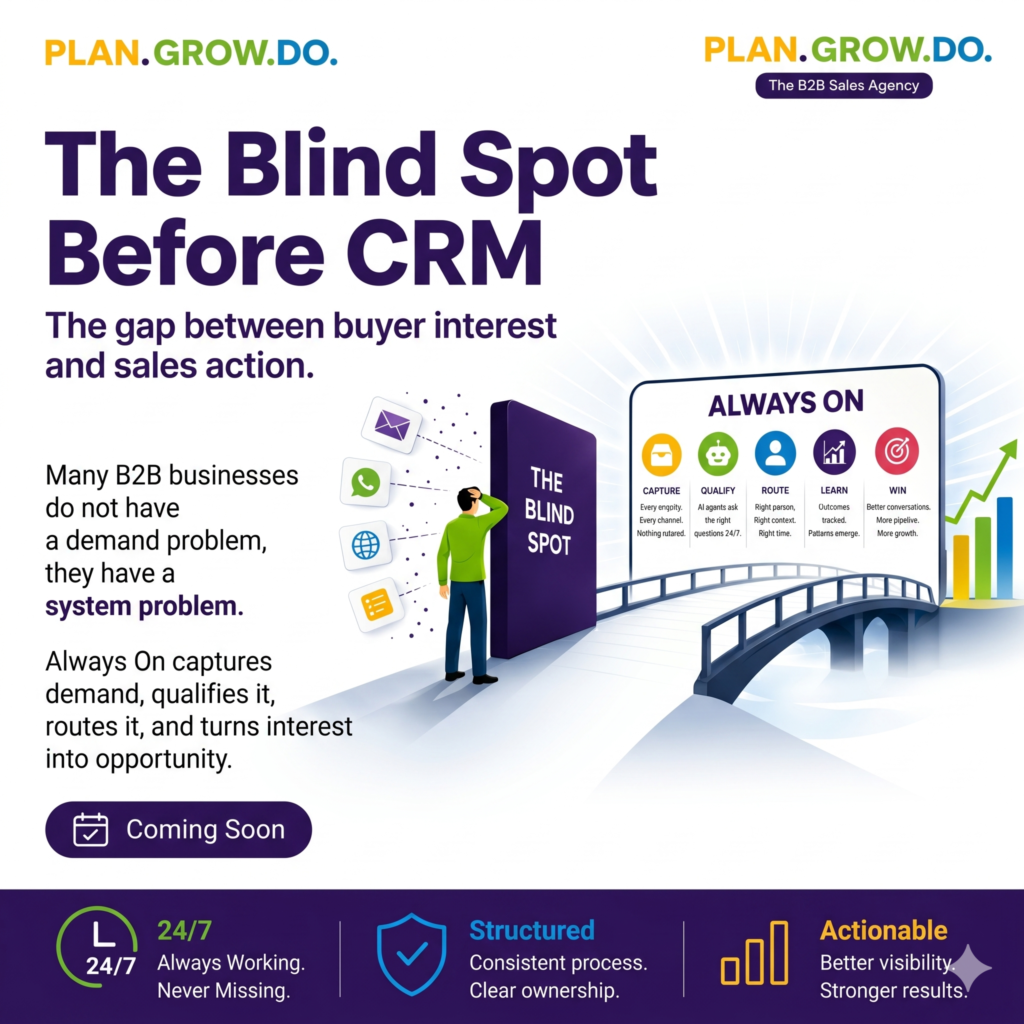
The Blind Spot Before CRM
I’m genuinely amazed watching technology finally catch up with a gap I have seen in
B2B sales for years.
When you spend time working with businesses on CRM, sales process, pipeline discipline and sales excellence, you begin to notice something that is easy to
overlook.
The CRM is not really the beginning.
It is where the business hopes the opportunity becomes visible, structured and manageable. It is where sales teams record activity, update stages, add notes, manage forecast, and try to show what is happening across the pipeline.But before anything reaches that point, there is another space.
Most sales leaders can see the CRM once the opportunity is created. They can review pipeline. They can challenge stages. They can look at close dates, values, probabilities and next steps.
But what about the opportunities that never became opportunities?
What about the enquiries that were missed, delayed, poorly routed or treated as lower value than they really were?
What about the high-potential technical question that was handled like a simple price request?
What about the prospect who needed a fast, knowledgeable response but received a generic “can you send more details?” reply several hours later?
What about the marketing campaign that generated interest, but no one can clearly connect that interest to a qualified sales conversation? That is the commercial blind spot.
And for Managing Directors and Sales Directors, it matters because it affects more
than admin.
– It affects speed of response.
– It affects pipeline quality.
– It affects sales productivity.
– It affects marketing ROI.
– It affects CRM accuracy.
– It affects the buyer experience.
It affects whether the sales team spends time on the right opportunities, with the right context, at the right moment.
For years, we have tried to solve this with process. Better CRM adoption. Better sales behaviours. Better qualification. Better manager rhythm. Better follow-up discipline.
All of that still matters.
But I think something has changed. The technology is now catching up with the gap.
– We can now start to connect the space between buyer interest and sales action in a much smarter way.
– We can capture enquiries from multiple channels.
– We can respond immediately.
– We can qualify before the salesperson gets involved.
– We can route the enquiry to the right person.
– We can give the rep context before the first conversation.
– We can track what happens next.
We can help managers see not just what is in the CRM, but what is trying to get into the CRM.
That is exciting. Because the businesses that solve this gap will not just become quicker. They will become sharper.
– They will know what demand is coming in.
– They will understand which channels are working.
– They will see which enquiries are worth prioritising.
– They will reduce the leakage between interest and action.
– They will give their sales teams a better starting point.
And perhaps most importantly, they will stop relying on hope, habit and individual memory to manage one of the most important moments in the buyer journey.
The first moment of interest. That is the gap we have been working on. Because in many B2B businesses, the issue is not that there is no demand.
The issue is that demand is not always captured, qualified, outed, acted on or learned from consistently enough.
The solution is coming soon.
Always On from Plan Grow Do.
The B2B sales control system that never clocks off.