Share this article
Standing Out or Just Blending In? Why Lubricant Messaging Often Misses the Mark
Walk into any trade show hall, like I did at Lubricant Expo in Düsseldorf recently, and you’ll be greeted by a forest of banners, screens, and stand walls all competing for your attention. The challenge? Much of the messaging looks and sounds the same.
👉 “Partners in every solution”
👉 “Your partner for endless possibilities”
👉 “Technology leadership where it counts”
These are safe, broad statements. They’re credible enough. They reassure buyers that the company behind the stand is reliable and established. But here’s the problem: they could sit on the wall of almost any stand in the hall. Swap the logos around, and no one would notice.
In a sector as competitive as lubricants, where differentiation is notoriously difficult, this risks leaving brands blending in rather than standing out. And when you blend in, you become invisible.
Why Do Brands Default to Generic Messaging?
There are a few reasons why lubricant companies end up leaning on broad statements:
Fear of exclusion – A line like “partners in every solution” feels safe because it doesn’t risk leaving anyone out. It applies to automotive, industrial, marine, and beyond. But by trying to appeal to everyone, it fails to resonate with anyone.
Comfort in tradition – Many of these statements have been around for decades. They’re easy to sign off because no one objects. They sound professional, familiar, and neutral.
Complexity of the value proposition – Lubricant businesses are complex, often spanning blending, additives, distribution, service, and technology. It can feel easier to hide behind general language than to distil something sharp and outcome-focused.
Internal alignment over external impact – Too often, messaging is written to satisfy the boardroom rather than the buyer. Broad slogans are a compromise that everyone inside the business can live with — but they don’t always hit home with the market.
The Risk of Blending In
The danger of generic messaging is simple: it makes you forgettable. Buyers in the lubricants sector are bombarded with noise. Research tells us that up to 80% of buying decisions are made before salespeople are even contacted. That means the first impressions buyers form online or at events are critical.
If your message looks like everyone else’s, it’s harder to cut through. And when buyers don’t see a reason to choose you over the competition, they default to the only differentiator left: price.
This is where broad slogans can hurt. They don’t create memory hooks. They don’t anchor your brand to a specific outcome. And they don’t make the buyer think “this is for me.”
The Case for Outcome-Based Messaging
Now contrast that with outcome-focused messaging. This is language that speaks directly to what buyers want, in their own words.
At Plan Grow Do, we’ve wrestled with this challenge ourselves. As a B2B sales training agency, we could have gone down the same generic path: “Sales training that works” or “Your partner in growth.” Safe, yes. Differentiating, no.
Instead, our strapline became:
“Confidence, process, and structure in sales.”
It’s still clear and concise. But here’s the difference: it’s outcome-based. It’s built on feedback from our customers. Time and again, sales leaders told us they wanted their teams to be more confident, to follow a repeatable process, and to have structure in how they approached buyers.
That outcome-focus gives our message weight and credibility. It’s not what we think we offer. It’s what our clients told us they needed.
Read more about the alignment of sales and marketing in the lubricants industry.
Broad Statements Still Have a Place
It’s important to be clear: broad brand statements aren’t bad.
They play an important role in marketing strategy.
They build trust – Phrases like “partners in every solution” or “technology leadership where it counts” are credibility builders. They reassure new prospects that you’re safe to work with.
They unify internally – Simple, broad slogans often act as a rallying cry inside the business. They keep people aligned around a high-level vision.
They create a platform – As an umbrella, they provide room to develop more specific campaigns underneath them.
The key is recognising that these statements are starting points, not differentiators. If they’re all you’ve got, you risk fading into the background.
How to Move From Blending In to Standing Out
So, what can lubricant companies do to sharpen their messaging and cut through the noise? Here are five practical steps:
Start With the Buyer’s Language
Go beyond internal brainstorming. Interview customers. Read through proposal feedback. Pay attention to the words they use to describe their challenges and outcomes. Build your messaging from that language.
Anchor in Outcomes, Not Inputs
Instead of focusing on what you do (“we deliver solutions”), focus on what that means for the buyer (“we cut downtime,” “we extend equipment life,” “we help you win more contracts”).
Differentiate by Segment
The lubricants market is fragmented. Marine buyers care about compliance and sustainability. Industrial buyers care about uptime and efficiency. Fleet managers care about fuel savings and total cost of ownership. Tailor messaging by persona rather than trying to catch everyone with one line.
Test and Refine in the Field
Don’t wait for perfection. Test straplines, campaigns, and messages in the market. See what resonates. Use digital data, event feedback, and sales conversations as your testing ground.
Build a Hierarchy of Messages
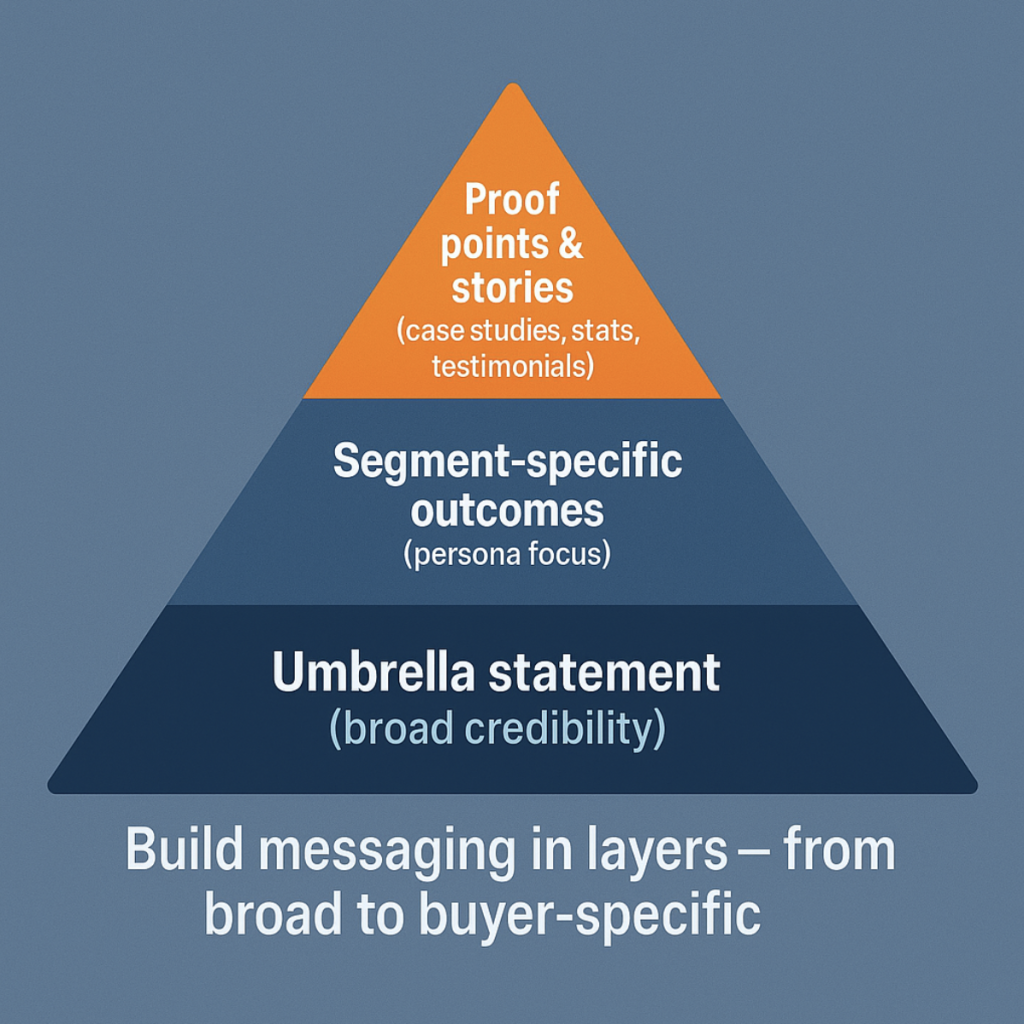
Think in layers:
Umbrella brand statement (broad credibility builder)
Segment-specific outcomes (persona-focused differentiators)
Proof points and stories (case studies, stats, testimonials that bring it all to life.
This layered approach allows you to benefit from broad positioning and sharp differentiation.
Examples of Standing Out
When brands get this right, it’s noticeable. Imagine walking through the expo hall and seeing these alternatives:
- Instead of “Your partner for endless possibilities”, a sign reads: “Cut downtime by 30% with lubricants engineered for heavy industry.”
- Instead of “Technology leadership where it counts”, you see: “Proven to extend fleet service intervals by 25%.”
- Instead of “Partners in every solution”, you’re greeted by: “Helping marine operators meet IMO compliance without compromising performance.”
Suddenly, the message is sharper. It’s buyer-centric. It’s memorable. And it’s anchored in outcomes.
Read more about standing out vs adding to the noise: https://plangrowdo.com/buyer-revolution/if-youre-not-adding-value-youre-adding-noise-whatbuyers-really-want-from-account-managers/
The Bigger Picture: Messaging as a Competitive Advantage
Lubricants may be a technical, product-heavy industry, but buyers still make decisions based on clarity, trust, and differentiation. Messaging isn’t a nice-to-have. It’s a commercial lever.
Clear messaging accelerates buying cycles because buyers quickly see relevance.
Outcome-based positioning reduces price pressure because the focus shifts from cost to value.
Buyer-led language increases trust because prospects feel understood.
In a market where technical specifications are often comparable, messaging is one of the few levers left to truly stand out.
Final Thought
At Lubricant Expo, surrounded by walls of generic statements, it’s tempting to shrug and say “that’s just how this industry talks.” But every generic line is also an opportunity. An opportunity to do something different. To speak directly to what your buyers want. To stand out, rather than blend in.
The pun might be lighthearted, but the point is serious:
If you keep blending in, you’ll be invisible. If you stand out, you’ll be remembered.
So the next time you’re tempted to sign off on a safe, broad slogan, ask yourself: does this make us different in the eyes of our buyer? Or does it just help us blend in with everyone else?
The companies that choose the former will own the future.
Further Reading from Across the Web
If you’d like to dive deeper into how brands can sharpen their messaging and stand out in competitive B2B markets, here are some useful resources. CMSWire explores why brand differentiation is central to effective B2B marketing, while BrandingMag highlights the importance of authenticity in messaging. For practical advice aimed at ambitious companies, Startups Magazine shares how bold branding can fuel growth. To understand how branding sits alongside marketing execution, Digital Authority clarifies the distinction between the two, and Industrial Strength Marketing outlines the marketing services that help B2B firms move from blending in to becoming truly memorable.