Share this article
Never Boring: Gemma Stephenson on Making Sustainability Useful
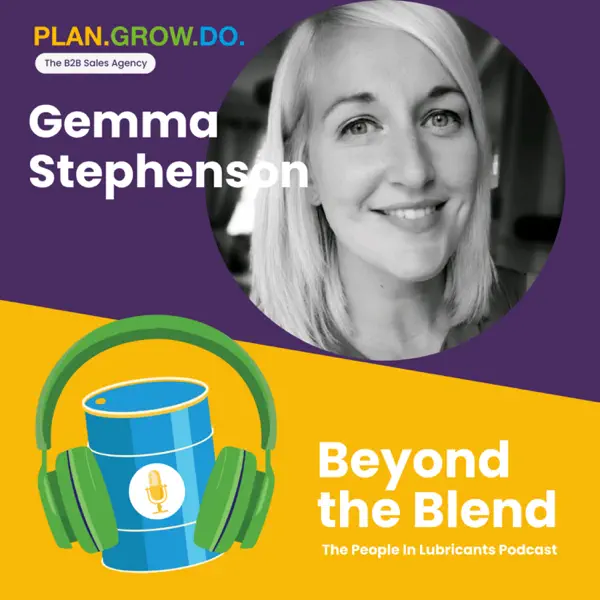
What happens when a tribologist who loves the lab learns to love the microphone just as much? In this edition of Beyond The Blend, Steve Knapp sits down with Gemma Stephenson of Cargill to explore a career that bridges science, sustainability and commercial impact. From PCF acronyms to classroom wind turbines, Gemma’s story shows how purpose and practicality can live in the same conversation and why the industry moves faster when people talk to each other. Here are the standout themes and what they mean for everyday decisions in lubricants.
From lab coat to leadership
A career built on curiosity and backing: Gemma’s journey began in 2012 at Croda’s labs, where the real-world, technical challenge of lubricants clicked instantly. Mentored by John Eastwood, she was nudged towards conference platforms and customer meetings, translating test data into stories that made sense to buyers. That progression from MTM rigs and blends to keynotes is a reminder that careers often grow where enthusiasm meets sponsorship. Encouragers who open doors and insist you take the stage are career multipliers. Gemma’s arc shows how credibility earned in the lab can become clarity delivered in the boardroom.
Nerves are normal, community helps: Presenting in male-skewed rooms was daunting at first. Over time, familiarity with the circuit and candid chats with peers revealed a levelling truth; perhaps even seasoned names feel nervous.
Confidence compounds with repetition and community. The message for emerging talent is simple. Put yourself in the room, borrow belief from mentors, and let the quality of your work carry you. Influence often begins as explanation, and explanation begins with showing up, again and again, until the story becomes second nature.
Making sustainability useful
From abstract to actionable: Carbon acronyms can feel distant. Gemma’s challenge to the industry is to anchor PCF and LCA in the decisions real people make. A developer needs to understand trade-offs in design. A buyer cares about cost, continuity and risk. A plant manager looks for uptime and safety. The question is always, “so what for me?” By tailoring both the metric and the message to role, sustainability stops being an audit exercise and starts being a lever for performance, resilience and value. The next step is clearer shared guidance that demystifies the terms.
Sustainability as a product requirement: What used to be an afterthought is now baked into innovation. New chemistries are being evaluated with both performance and footprint in mind. This is not about green badges added at the end, but design that begins with fewer compromises between outcomes. When sustainability sits beside viscosity, traction and durability in the brief, you change how teams ideate and prioritise. In practice, that means earlier engagement between technical and sustainability colleagues, clearer targets, and a commitment to communicate the benefit in language each customer role recognises.
The rise of the Sustainability Manager
Translator and decision shaper: In customer meetings, the Sustainability Manager is increasingly present, absorbing purchasing realities, technical constraints and commercial targets, then applying a sustainability lens. That role does not replace others, it connects them, and in many organisations now carries real decision weight. If you sell, plan for that conversation. If you buy, empower that role with the right data. If you develop, invite that voice into the brief. This bridge function reduces friction and improves choices, provided the information shared is timely, comparable and relevant.
From volume to value: Value conversations now include sustainability alongside TCO, uptime and compliance. That shift changes CVPs and the questions sales teams ask. Buyers want innovation that solves more than one problem at once. A credible offer therefore explains the operational benefit, the footprint story, and the practicalities of supply, service and end-of-life. When these points are joined up, price is contextualised and procurement can make a balanced call with wider stakeholder support.
Equipping sales teams to talk sustainability
Beyond a generic deck: Gemma’s marketing stint reinforced that one slide-deck to rule them all does not work. Equip teams with role-specific prompts, question sets, and concise explainers they can adapt. Focus on discovery as much as delivery. Teach reps to ask the right questions about footprint priorities, regulatory drivers, and performance thresholds. Provide short narratives that link the customer’s world to your chemistry choices. The aim is not to talk at customers, but to co-define the problem, then evidence how your solution addresses it, including sustainability that is meaningful to them.
Account-based messaging, not mass broadcasting: Replace broad, eco-label overviews with tailored, account-level stories. For one customer, pump efficiency is the hook. For another, third-party-verified PCF comparability unlocks internal approval. Build small libraries of field-tested proof points and keep them fresh as regulations and methods evolve. The internal win is cultural. When sustainability is discussed daily on office screens and in team huddles, it becomes normal for sales to lead with value, not volume, and to evidence claims with data customers can use.
Collaboration across the chain
Talk to each other: Progress accelerates when OEMs, additive suppliers, formulators, end users, agriculture and regulators share what they are doing, why and how. Work often happens in silos. The industry needs more rooms where priorities are compared, duplication is avoided and methods are aligned. Collaboration shortens the path from idea to implementation and reduces mixed messages to the market. It also helps everyone tell a clearer story to customers and policymakers. The lubricant sector has the forums. The ask is to use them deeply and often.
UEIL’s practical momentum: The sector’s common voice matters. Recent moves include a third-party-verified PCF methodology and an upcoming best-practice webinar on end-of-life handling. These are not slogans, they are tools teams can use. Companies outside specialty chemicals are learning from lubricants too. The more the industry lands shared, credible methods, the easier it becomes for customers to compare, decide and justify change internally. Advocacy is rising, and it needs participants, not spectators.
Advocacy and STEM
Change the perception early: Many still think “lubricants” means something else, or conjure images of dull, dirty work. Gemma and colleagues at UKLA and UEIL are building school-ready toolkits to make friction, fluids and sustainability tangible for children. Think cereal-box wind turbines and hairdryers, not grey coats and grey slides. If you can spark one light-bulb moment, you change a career path later. Industry pride grows when the next generation sees why this work keeps the world moving cleanly and efficiently.
Personal energy, public good: The most striking thread in this conversation is how Gemma’s enthusiasm turns heavy topics into human ones. That matters for classrooms and conference halls alike. If advocacy sounds like you, borrow this playbook. Make it real, make it relevant, and show the result. The point is not to boast, but to widen the circle of people who understand the value lubricants deliver and the responsibility the sector accepts. Done well, advocacy brings talent, partners and pace.
Summary
This episode shows how a technical foundation, a mentor’s nudge and a clear sense of purpose can shape both a career and a conversation. Sustainability becomes useful when it is role-specific, evidenced and embedded from the brief onward. Sales enablement must shift from decks to discovery. Progress speeds up when the chain talks to itself honestly. And the future gets brighter when we invite children to play with the science that keeps the world moving. It is, as Gemma says, never boring.
Enjoyed this? Subscribe to Beyond The Blend for more honest conversations with the people moving our industry forward. Share the episode with a colleague and tell us the one action you will take in your next customer conversation.