Share this article
From Newsroom to Base Oils: How Storytelling Shapes Modern Market Insight
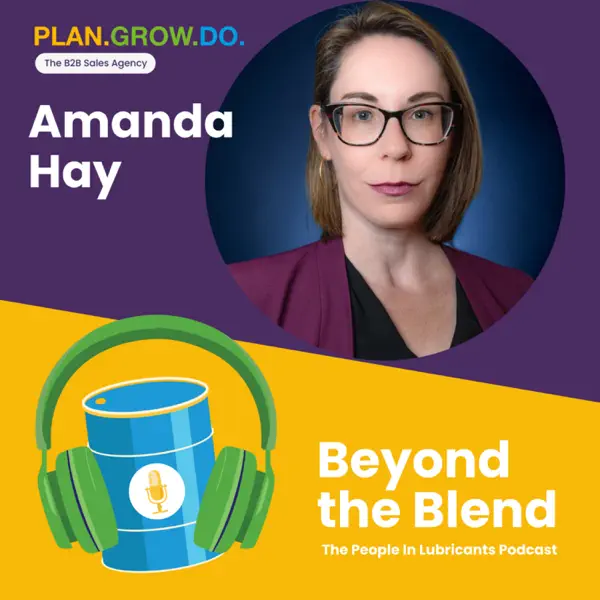
The lubricants market can often seem dominated by numbers, forecasts and economics, but behind the graphs are people whose creativity, curiosity and lived experience shape how the industry understands itself. In this episode of Beyond The Blend, we meet Amanda Hay, Global Lead for the Base Oils Squad at ICIS, whose unconventional journey from community journalism to commodity data shows how storytelling, insight and human connection still matter in a rapidly evolving sector.
The environment in which we grow undoubtedly shapes us. Time and again we hear and see the old adage it’s not like that here. We do things like that here. A job for life! Work hard you’ll get paid more!
But likewise working with the more modern sales teams and future managers and leaders we see that money in itself isn’t the main motivator. We see the corporate purpose and vision playing an important part.
Sales is changing. It has had to, thanks not only to the worldwide pandemic but also because the “new kids on the block”, aka the millennial generation, have an entirely different perspective on the world. We talk more about this too in our book Modern Sales Leadership which is available on Amazon and direct from the link at the bottom of the article. – Modern sales leadership by rob taylor & Steve knapp.
What are the different lenses of the generations at work?
Journalism roots in a digital world
Amanda’s career began with a deep love for community journalism, long before base oils entered her life. She speaks fondly about newsrooms, neighbourhood reporting and the privilege of telling a community’s story. That world has changed. Digital disruption hollowed out local newsrooms, and mass layoffs took a heavy toll on the profession. Yet the foundations of journalism remain relevant.
Curiosity, ethical discipline, the ability to ask better questions and the resilience of working to constant daily deadlines all shaped the professional she became. These skills transferred almost seamlessly into market reporting and data intelligence. In her role today she still feels the responsibility of accuracy, clarity and service to the reader, even if the audience has shifted from local communities to global industries.
A global industry with real reach
One thread running through Amanda’s role is the incredible global scope of the base oils sector. From Cape Town to São Paulo, Singapore, New York and the Middle East, the industry connects continents and cultures. The travel can be tiring at times, but Amanda sees it as one of the most exciting parts of her job and a strong draw for new talent. Although base oils is a close-knit community, its impact and operations are truly global.
Events like the World Base Oils Conference show how interconnected the market has become, with regional developments influencing decision-making across the world. For younger professionals considering their options, Amanda champions the idea that journalism and communication skills can open doors to international opportunities they may not have considered.
Data and storytelling working together
Amanda is clear that data alone is not enough. Nor is story without substance. The real value sits in joining the two. Buyers are time-poor and want clear, trusted intelligence that is easy to absorb. ICIS has been shifting from traditional news publishing towards data-led insight, where visualisation, intelligence and narrative come together.
Amanda describes how customers often oversimplify markets by tracking crude prices alone. Her team helps them understand the true dynamics of base oils, from refinery decisions to supply and demand movements. The rise of data journalists at ICIS reflects this shift. Their job is not only to gather information, but to frame it visually and narratively in ways that allow customers to make better decisions.
The overlooked power of great design
A standout theme in the conversation is Amanda’s passion for visual communication. Years working in graphic design made her sensitive to the frustrations that many industry professionals share: overcrowded slides, indistinguishable colours, graphs that overwhelm rather than clarify. She believes strongly that design is not decoration.
It is communication.
Whether for neurodivergent audiences, busy decision-makers or customers trying to grasp complex market forces, good visual storytelling makes the difference between insight and confusion. Amanda argues that more companies should take design seriously, investing in the people who can translate complex data into clarity. In her words, no presentation benefits from packing everything onto one slide. Less is almost always more.
Thriving under pressure and working as a team
Despite moving sectors, the adrenaline of newsroom deadlines remains part of Amanda’s life. The pace of market reporting is relentless, and her team often finds themselves working in demanding circumstances. She recalls Hurricane Harvey in 2017, where the entire team worked remotely while flooded in, long before remote working was commonplace. Power cuts from ice storms and hurricanes have seen colleagues working from cars simply to keep the market informed.
These situations build camaraderie and a sense of shared purpose. For Amanda, it is a reminder that journalism’s spirit of service is still alive in the commodity world.
Navigating AI with purpose and perspective
AI is no longer a promise on the horizon. It is already embedded in how ICIS gathers and interprets data. Amanda explains how their AI tools help customers make sense of enormous datasets and find answers faster. The message is not fear but adaptation. In her view, professionals who resist AI risk being overtaken by it.
The goal is to let AI support the human skills that still matter: interpretation, ethics, storytelling and relationship building. Buyers still want a human connection, even if the timing and channels of that connection are changing.
Read more about AI and the lubricants industry in the special Lube News edition where Rob Taylor highlights the opportunity for AI to help us, not replace us!
Creativity, passions and personal grounding
When she is not analysing markets, Amanda turns to photography for creative expression. Influenced by her father’s work as a professional photographer, she carries that artistic lens into her personal life. She only displays photos she has taken herself, valuing authenticity and connection to place. Time for writing is limited, but the creative instinct remains. It is a reminder that even in data-driven roles, personal creativity shapes how people interpret and communicate ideas.
Advice for early career professionals
Amanda’s advice is simple but powerful. Keep an open mind. The career you imagine at 21 rarely matches the path you take. Journalism skills can open doors into industries you never expected, including commodities and data intelligence. She encourages people to spot gaps, step forward and shape their own opportunities. As she was told early in her ICIS career, if you think there are no opportunities, you are not looking hard enough. The responsibility and the potential sit with you.
Summary
This episode of Beyond The Blend gives a refreshing look at the people behind the data. Amanda’s journey shows how journalism, creativity and curiosity can shape a compelling career in the lubricants and base oils world.
Her reflections on data storytelling, design, AI and global industry dynamics offer valuable lessons for anyone navigating change in their career or sector.
Call to action
If you enjoy conversations that bring the human side of the lubricant market to life, subscribe to Beyond The Blend and stay connected with future episodes, insights and stories from across the industry.
🎧 Spotify : https://lnkd.in/e54d3ytz
🎙️ Apple : https://lnkd.in/ecu_uTiq
🎬 YouTube : https://lnkd.in/erBRpKJ3