Share this article
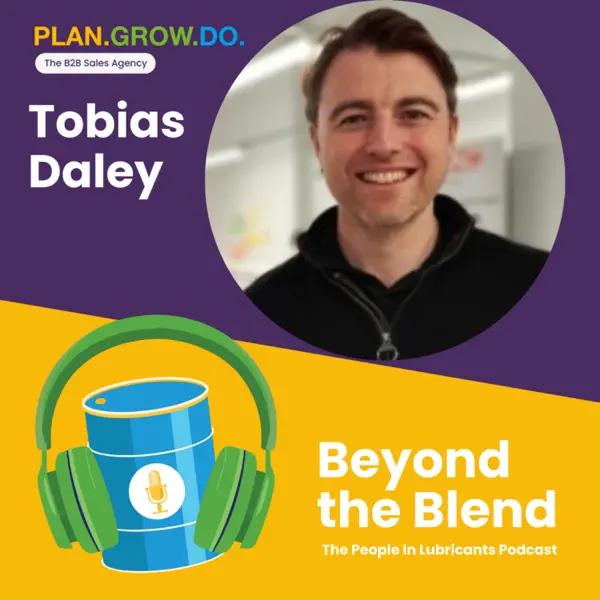
From the Van to the Boardroom. A Human Story of Leadership, Learning and Innovation with Tobias Daley
episode of Beyond the Blend, Tobias Daley (HYDAC) shares a journey that starts not in a boardroom, but in workshops, test rooms, service vans, and industrial sites across the UK and beyond. His story is a reminder that many of the most influential leaders in the lubricants and fluid power world did not plan a linear career. Instead, they followed curiosity, learned through doing, and built credibility the hard way. This article explores the themes that shaped Tobias’ path and what they tell us about leadership, innovation, and the future of the industry.
Apprenticeship as a foundation, not a limitation
Tobias’ career began with a mechanical engineering apprenticeship, shaped by time in design offices, test environments, and hands-on hydraulic work. Rather than being a stepping stone to move past quickly, the apprenticeship formed the backbone of how he still thinks today. Exposure to real systems, real failures, and real pressure created an understanding that no classroom could replicate. This early grounding gave him confidence on site and credibility later in leadership roles. The theme here is clear. Deep technical foundations, built early, create better innovators and better leaders over the long term.
Seeing the industry from the inside out
Working on power stations, offshore equipment, infrastructure projects, and transport systems gave Tobias a panoramic view of how lubrication and fluid power quietly support modern life. These experiences shaped his appreciation for problem solving under pressure and the human side of engineering. Being called out when things failed, often at unsociable hours, taught resilience and responsibility. Crucially, it also revealed how disconnected many people are from the industries that power everyday life. The industry’s impact is vast, but its story is rarely told in a way that connects emotionally or practically with wider audiences.
“You’re there because you’re more of an expert than the person on site, otherwise you wouldn’t be there. So you have to make it in a way that everybody can understand what we’re trying to do.”
Mentors who push, not protect
A recurring theme in the conversation is mentorship. Tobias credits mentors who combined deep technical expertise with the confidence to step back at the right moment. Being pushed to present complex ideas alone, rather than relying on senior experts, marked a turning point. These moments were uncomfortable but transformative. They forced ownership, accelerated learning, and built trust. The lesson is simple but powerful. The best mentors do not shield people from challenge. They prepare them, then let them step forward and carry responsibility themselves.
Building credibility in a traditional industry
Fluid power and lubrication remain experience-led industries, where age and tenure often influence trust. Tobias navigated this by focusing on clarity rather than authority. He learned to visualise problems, simplify explanations, and communicate outcomes in a way that made sense to everyone on site. Credibility came from consistency and delivery, not titles. This approach also helped bridge generational and disciplinary gaps. The ability to translate complexity into shared understanding became one of his most valuable skills as he moved from technical roles into leadership.
“We were so focused on the technology itself, not the bigger picture.”
Innovation grows through diversity of thinking
The HYDAC Business Innovation Group emerged informally through collaboration across countries before becoming a formal global function. Diversity here is not framed as a corporate slogan, but as a practical advantage. Different cultural approaches, educational backgrounds, and ways of thinking improved decision-making and creativity. From engineers to software specialists and facilitators, the mix challenged assumptions and avoided groupthink. Innovation, in this context, is less about breakthrough ideas and more about creating environments where different perspectives can be heard and tested safely.
Leadership rooted in being human
Tobias speaks openly about imposter syndrome and the pressure to fit traditional leadership moulds. Over time, he learned that authenticity mattered more than imitation. By leading as himself, rather than who he thought a leader should be, he created a team culture based on trust, openness, and psychological safety. Work is treated as a human environment, not a machine. People are supported when they struggle and encouraged to grow. Leadership becomes less about control and more about creating the conditions where people can do their best work.
People first, technology second
Despite working at the intersection of digitalisation, sustainability, and innovation, Tobias is clear that technology alone does not deliver value. Tools only work when people understand them, trust them, and can see their impact. Whether it is fluid condition monitoring, asset management platforms, or energy reduction models, adoption depends on education and relevance. The future lies in combining technical capability with skilled people who can translate data into decisions and measure outcomes in ways that matter commercially and environmentally.
The industry needs to tell a better story
One of the strongest themes is that the lubricants and fluid power sector undersells itself. Its contribution to energy, transport, data infrastructure, and sustainability is enormous, yet poorly articulated to young people and the wider public. Tobias argues that purpose already exists, it is just not communicated well. When framed through everyday life, from power generation to manufacturing and data centres, the value becomes obvious. Attracting the next generation will depend less on technical detail and more on connecting work to real-world impact.
Summary
This conversation highlights a career shaped by experience, mentorship, curiosity, and a strong sense of purpose. From apprenticeship to global innovation leadership, Tobias Daley’s journey reinforces that progress in the lubricants and fluid power industry depends on people as much as technology. Clear communication, diverse thinking, and human leadership emerge as consistent threads. The future, as described here, is collaborative, open, and grounded in measurable impact rather than buzzwords.
Check out Beyond The Blend!
If you want to hear the full conversation and explore more real stories from across the lubricants industry, subscribe to Beyond the Blend. Each episode goes behind the job titles to understand the people, experiences, and thinking that are shaping the future of the market.