Published 9 October 2025 · Last updated 15 July 2026
Share this article
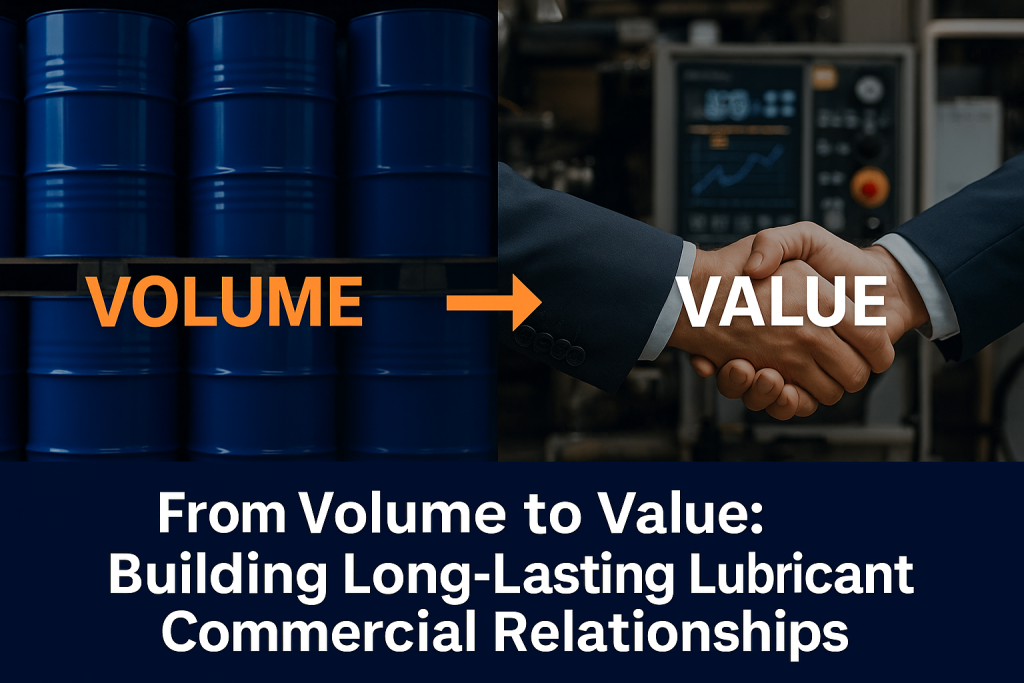
From Volume to Value: Building Long-Lasting Lubricant Commercial Relationships through Application-Led Conversations
Have you noticed the change? Buyers are more informed, empowered, and expectation-driven than ever before. They don’t just purchase oils or greases but they seek solutions that reduce downtime, extend equipment life, and optimise cost per operating hour.
Yet, many sales teams still lead with product-led conversations; focusing on specifications, grades, discounts, and supply quantities. This approach may sell volume in the short term, but it misses the opportunity to create trust, embed your expertise, and develop deeply loyal, long-term relationships.
What if, instead, sales reps shift to an application-led style of selling, one that starts from the buyer’s challenges and goals, and translates lubricant expertise into business outcomes? Volume may dip initially, but the true value this creates yields stronger commercial bonds, higher margins, greater advocacy, and sustainable growth.
In this article, we’ll explore:
- Why product-led selling is losing effectiveness
- How the Buyer Revolution data points to what lubricant buyers truly value
- The conflict between volume-focused business imperatives and value-led relationship building
- What application-led selling looks like, with practical tips and frameworks
- How companies and reps can make this shift
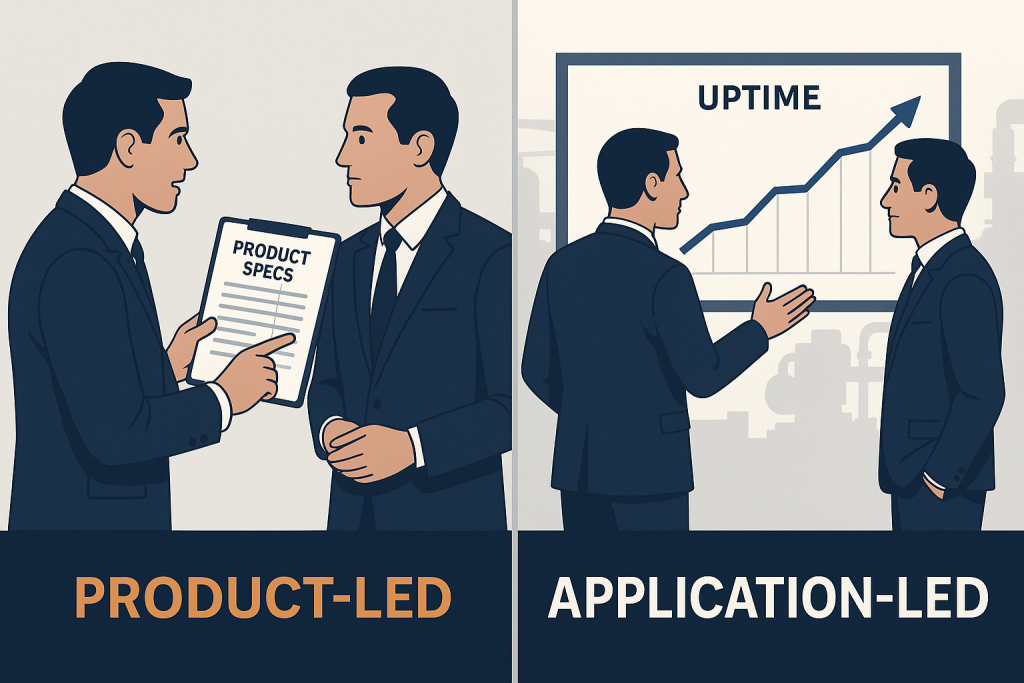
Why Product-Led Selling Is Losing Effectiveness
Buyers are smarter, more empowered
Thanks to digital resources, buyers often arrive at conversations knowing lubricant products inside out. They’ve researched viscosity grades, deposit control, compatibility, and shelf life. A rep who just recites features adds little; what matters is insight. As noted in broader B2B sales research, product specs alone no longer differentiate challengers, whereas values and outcomes do. McKinsey & Company+1
Feature lists don’t build trust
A conversation framed around product spec sheets or price volumes tends to be transactional. Buyers want strategic partners — reps who understand uncertainties around machine uptime, maintenance scheduling, total cost of ownership, and environmental/sustainability priorities.
Context matters more than commodity
In the lubricant industry especially, application context such as operating temperature ranges, machinery type, viscosity index, oil change intervals, ambient contaminants, drastically alters the best choice. Selling without this context risks value leakage and undermines confidence.
Buyer Revolution Insights: What Buyers Really Want
The Buyer Revolution survey series by Plan Grow Do offers rich, direct feedback from lubricant buyers. A few points of focus:
- The Sales Rep / The Account Manager reveals buyers want reps who go beyond filling orders: they want partnering on reliability, performance, and cost efficiency. Plan Grow Do
- Six Transformative Insights indicate buyers consistently emphasise technical understanding, proactive advice, responsiveness, and trust. LinkedIn
Overall, the Buyer Revolution shows clear desire from buyers for reps who ask about their operations, challenges, and performance goals — not just which lubricant they need. Plan Grow Do
These insights underscore that buyers reward application-led conversations with commercial decisions and long-term loyalty. Discover more about the changing lubricant buyer with The Buyer Revolution Online programme.
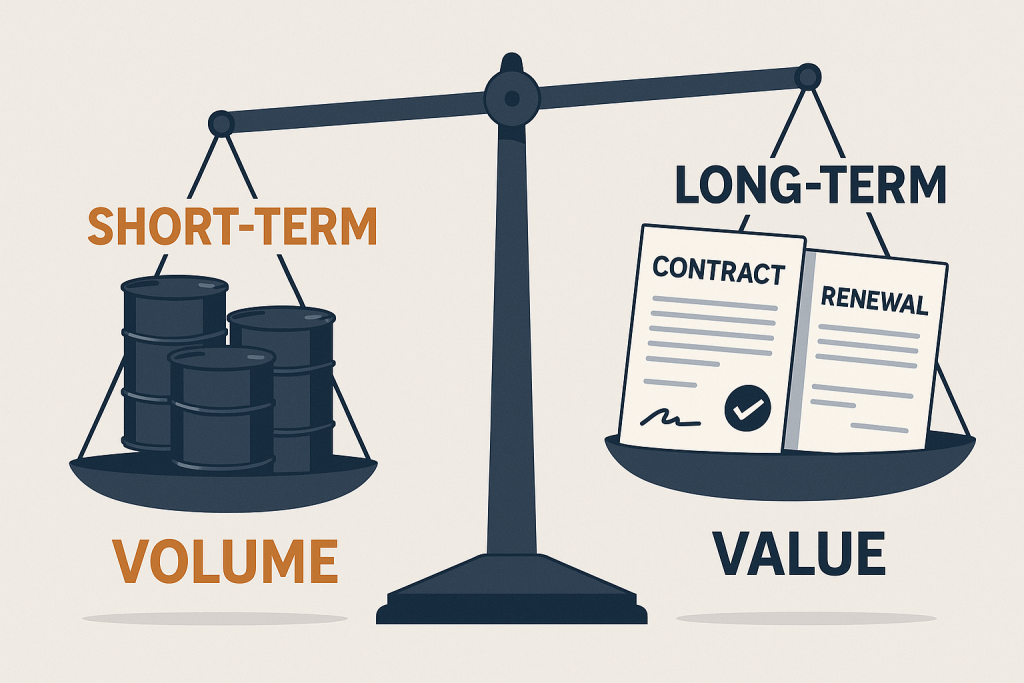
The Conflict: Volume Goals vs. Value Selling
The short-term pressure: volume quotas
Internal pressure to meet sales volume targets is real. High volume generates short-term revenue, satisfies forecasts, and maintains inventory flows. The product-led mindset aligns easily with this— fast, focused on numbers, and easily measured.
The long-term payoff: value-based relationships
But consider this: application-led conversations may sell less volume per transaction, but they often increase:
- Contract length. When buyers see strategic benefit, they renew longer.
- Share of wallet. You become their default supplier across multiple plants or divisions.
- Differentiation and margin. Value selling commands premium vs. discounting on bulk.
- Trust and advocacy. They recommend you to others and are less price sensitive.
So while volume might dip, commercial relationship strength grows and that is far more defensible and lucrative in the long run.
What Application-Led Selling Looks Like in Practice
Start from their problem, not your product
Ask questions like:
- “What’s your biggest maintenance headache right now?”
- “How often are you seeing unplanned downtime linked to lubrication issues?”
- “Which KPIs (e.g. MTBF, oil change interval, overall equipment effectiveness) matter most?”
Then link back: “Here’s how choosing the right base oil or additive package can improve X or reduce Y.”
Frame outcomes, not features
Instead of talking viscosity index or flash point, talk days of uptime gained per month, reduction in lubricant consumption, or lower total cost of ownership (TCO).
Share mini-case-studies or benchmarks
E.g.: “With a similar plant in your sector, we helped extend drain intervals by 33%, resulting in 120 extra operating hours per month and 15% cost savings annually.” Let the story illustrate the application.
Diagnose before prescribing
Treat each customer as unique. Listen, ask, and only when you understand their operations, recommend a solution. This aligns with solution selling methodology, where you sell a solution to a problem rather than a product. Wikipedia
Use data and visual tools
Dashboards, uptime vs. downtime charts, comparison of cost per operating hour — visual tools heighten credibility and make the conversation tangible.
Stay proactive between orders
Don’t just show up when it’s time to reorder. Monitor lubricant condition, alert your customer when their oil change is due, or if analysis reveals potential problems — becoming a consultative, proactive partner.
How to Make the Shift: Steps for Leaders and Reps
a) Align goals and incentives
If management rewards only volume, reps will default to product-led tactics. Introduce KPIs like:
- Number of application consultations held
- Insights delivered that led to operational improvements
- Customer satisfaction and loyalty metrics
- Value generated per customer (e.g. reduction in downtime)
b) Train reps in outcome selling
Invest in skills like questioning, listening, quantifying impact, storytelling, and tailoring recommendations. Use role plays grounded in case scenarios.
c) Develop supporting collateral
Create case studies, calculators (cost-saving, drain interval extension), videos with testimonials — so your reps don’t default to product sheets.
d) Integrate with marketing and technical teams
Work with technical service teams to produce insights. Collaborate with marketing to push educational content, webinars, or workshops centred on lubricant optimisation and problem-solving.
e) Pilot and measure
Choose key accounts for a pilot: train reps on application-led approach for 3–6 months, monitor differences in:
- Customer engagement and trust
- Volume vs. value mix
- Renewal rates and margin
- Share-of-wallet increases
- Then share successes to build buy-in.
Think in layers:
Umbrella brand statement (broad credibility builder)
Segment-specific outcomes (persona-focused differentiators)
Proof points and stories (case studies, stats, testimonials that bring it all to life.
This layered approach allows you to benefit from broad positioning and sharp differentiation.
External Frameworks & Inspiration
Product-Led vs Sales-Led Growth
This concept parallels the volume vs value dynamic: product-led approaches lean on the product to do the selling; sales-led approaches depend on relationships and consultative selling. Product School+1
McKinsey’s research on Product-Led Sales suggests hybrid models— blending product features with sales insight — yield superior results if done with discipline. McKinsey & Company
Solution Selling
An established methodology that focuses on identifying customer pain points and providing tailored solutions — the very essence of application-led lubricants conversations. Wikipedia
Real-World Example (Hypothetical)
Let’s imagine two sales reps for a hydraulic oil supplier:
- Traditional Rep “Volume-First Vince”
- Visits each customer with price promos.
- Pushes high volumes of standard AW32 and AW46 oils.
- Gets repeat orders but is treated as a commodity.
- Customer shifts suppliers whenever price drops — low loyalty.
- Application-Led Ally
- Begins by asking about hydraulic failure, their uptime, energy consumption.
- Learns the customer’s hydraulic pumps run hot and they struggle with oil oxidation.
- Suggests a high-viscosity-index, oxidation-resistant fluid tailored for higher-temp pumps, plus a monitoring program.
- Presents a scenario showing how extending oil life by 50% saves £X in downtime and change costs.
- Customer extends contract, includes sites in other regions, refers supplier to others — margins stay strong.
Over time, Ally generates fewer litres sold per delivery, but greater commercial value, stronger relationships, and higher contract stability.
The Path from Volume to Value
Market conditions, buyer expectations, and competitive dynamics are shifting — the lubricant industry is not exempt. Reps who cling to product-led, volume-first tactics may hit quotas in the short run, but they are setting themselves up for commoditisation and transactional churn.
Instead, let’s embrace application-led selling:
- Root the conversation in customer challenges and outcomes
- Prioritise reducing unplanned costs, extending equipment life, and raising operational KPIs
- Build trust through proactive guidance and technical insight
- Align internal incentives to reward relationship depth and value created, not just litres shipped
By navigating the shift from volume to value, lubricant companies and their sales reps become indispensable partners — creating commercial relationships that endure and grow.
For more about aligning with the expectations of the modern buyer, review our Sales Person Of The Future download. Available below.