Published 14 May 2025 · Last updated 15 July 2026
Share this article
From Tea Boy to Director: Neil Chahal on Leadership, Legacy and Lubricants
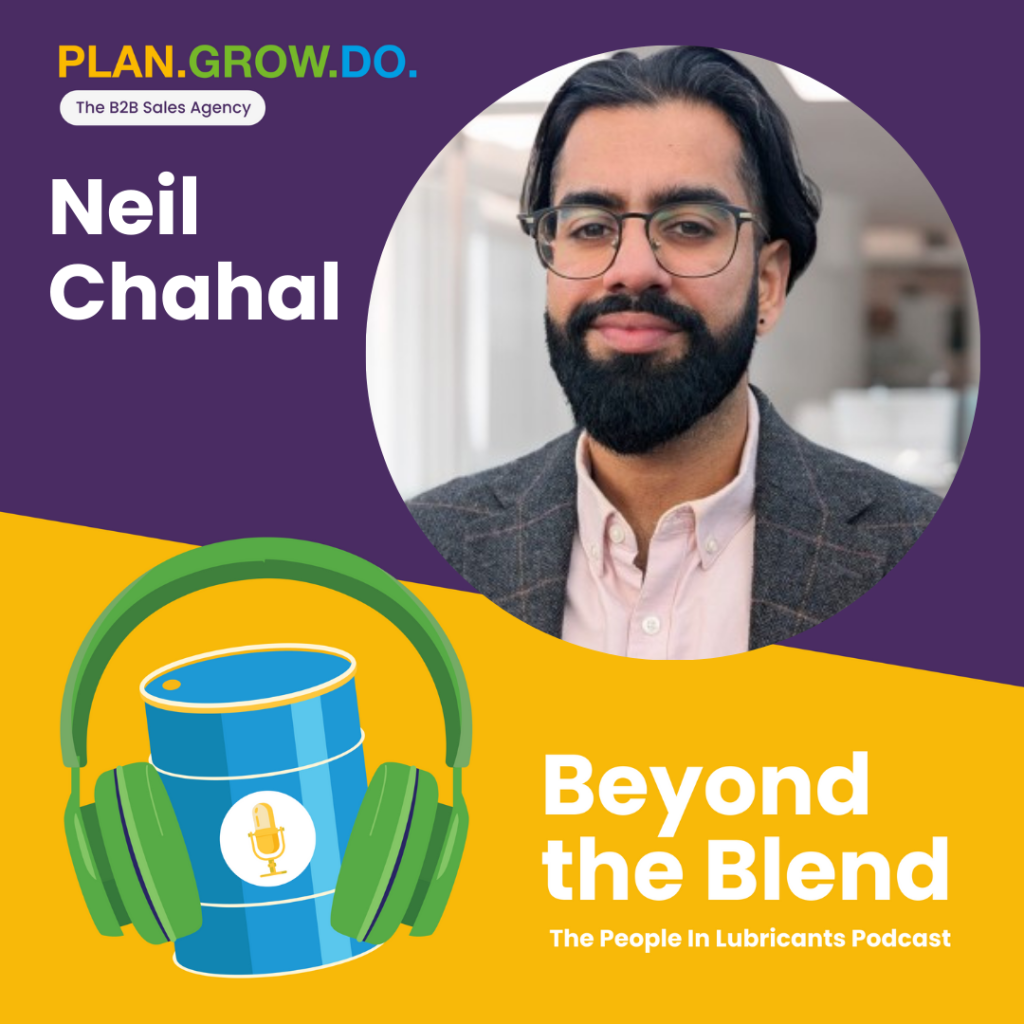
The lubricant industry is often described in terms of science, precision and heritage. But when Neil Chahal sat down with Beyond the Blend, it became clear that there is just as much space for personality, reflection and humour. Now Commercial Director at EL Oils, Neil’s journey is not one of fast-track privilege or academic accolades. It is the story of a self-aware leader who has worked his way through the ranks, from answering phones and shifting stock in the warehouse to leading the business with structure, empathy and purpose.
In a conversation that moved between serious insight and tongue-in-cheek storytelling, Neil gave a candid account of the values that drive him, the lessons he has picked up along the way, and the kind of future he believes the lubricant industry should be building.
Be sure to listen in and give Beyond The blend a thumbs up on your favourite podcast platform, Spotify or Apple Podcasts.
“I Can’t Just Stand Back and Watch Someone Struggle”
Neil doesn’t hesitate when asked how he would describe his leadership style. He leads by example and keeps the door open. Whether that means rolling up his sleeves in the warehouse or quietly picking up the slack when someone is overwhelmed, Neil sees leadership not as a badge of honour, but as a responsibility to others.
“If I see someone struggling, my immediate response is to take on that workload,” he explains. “You can’t be managing and also doing, but I can’t stand back and watch someone struggle.”
This mindset is more than just a personal preference. It has shaped how he builds teams, nurtures talent and creates a culture where people are encouraged to bring their full selves to work. For Neil, professionalism is not about stiff formality, but about consistency, communication and care.
A Journey Defined by Learning, Not Certainty
Neil’s entry into the sector was unplanned. Leaving sixth form after struggling with A-level chemistry, he took up an apprenticeship through his father’s workplace at EL Oils. At 17, he had no long-term plan, just a desire to work and learn.
“I’m not ashamed to admit that either,” he says. “I think it’s important that people, especially younger people coming through, know that it’s OK not to have it all figured out.”
Over time, Neil immersed himself in every aspect of the business. He learned to drive a forklift, took customer calls, worked with suppliers and explored sales. That early exposure gave him a broad base of experience, something he still values today. Several roles and promotions later, he found himself back at EL Oils, this time as Commercial Director.
“There was something romantic about it,” he reflects. “Going back to the place where I started out at 17, now 31, with all the experience I’ve picked up along the way.”
The Millennial Bridge: Balancing Tradition with Progress
Neil occupies a unique position in the workforce. As a millennial leader in a traditionally older sector, he has a foot in both camps. He understands the analogue systems and the hands-on ways of working, but he also embraces digital tools and social media. Rather than seeing this as a source of tension, he sees it as an opportunity to bridge the generational divide.
“We’re the generation that’s bridging the two,” he says. “You’ve got people in their forties and fifties who’ve done it one way, and people in their twenties who are completely tech-focused. Then there’s us, in the middle, who’ve seen both.”
What makes that work, according to Neil, is patience. Patience with those who are still adapting to digital ways of working, and patience with younger colleagues who may not yet understand the value of long-term experience. His approach is to foster understanding between teams, encouraging people to learn from one another rather than judge.
Hiring for Attitude, Building for the Long Term
When it comes to recruitment, Neil is clear: qualifications matter, but attitude matters more. He knows from personal experience that a degree is not the only pathway to leadership. What he looks for in new team members is curiosity, reliability and a willingness to learn.
“Attitude is everything. You can train knowledge, but you can’t train attitude,” he says. “Anyone that comes in here who’s warm, ambitious, eager to learn, they’re in.”
Neil also believes in setting people up for success. That includes structured onboarding, transparent systems and repeatable processes. He speaks passionately about the importance of detail, whether that is naming conventions in product codes or digital toolkits for salespeople, because he sees structure as the bedrock of scalable growth.
The Role of Technology: Enhancing, Not Replacing
Neil is no technophobe. He sees AI, automation and digital platforms as vital tools for improving both the customer and employee experience. But he is also cautious of relying on technology at the expense of personal connection.
“Yes, we can automate processing orders. Yes, telemetry has been around for decades. But when things go wrong, and they will, people want to speak to a human,” he says.
He points to simple innovations, like vehicle registration look-ups that automatically suggest the right lubricants, as ways to improve efficiency without losing the human touch. For Neil, the challenge is not whether to adopt technology, but how to make it meaningful in the specific context of the lubricant trade.
Looking Ahead: Culture, Confidence and Self-Reflection
As the conversation draws to a close, Neil is asked to share a lesson he would offer to his younger self or someone starting out in the industry. Without hesitation, he turns to the idea of self-reflection, something he practises regularly, even if it’s mid-shower.
“I’ll be talking to myself about stock, about an order, about a team issue,” he laughs. “My girlfriend will ask, who are you talking to? And it’s just me, working things out.”
What might sound like a quirk is actually a reflection of Neil’s broader approach to leadership. He is his own biggest critic and believes strongly in the power of regular introspection. It is this mindset, combined with humility, structure and humour, that makes his voice such a valuable one in the conversation about the future of the lubricant industry.
Conclusion: Redefining Leadership in a Legacy Industry
Neil Chahal may have started as a tea boy, but his journey through the lubricant industry has been anything but ordinary. He represents a new kind of leader, one who is deeply human, fiercely practical and unafraid to question how things have always been done. In an industry that often looks outward for innovation, Neil’s story is a reminder that some of the most powerful change starts from within.
“It’s OK not to have the answers,” he says. “Just keep learning, stay open, and treat people well. The rest will follow.”